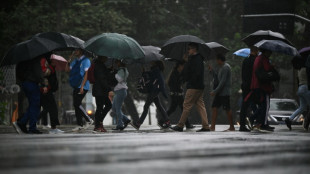
Summer 2023 was the hottest in 2,000 years: study / Photo: Tiziana FABI - AFP
Last year's northern hemisphere summer was the hottest in 2,000 years, according to a new study published on Tuesday.
Scientists say 2023 was the hottest year globally since records began in 1850, but the study in the journal Nature indicates human-caused climate change pushed northern summer highs well beyond anything seen in two millennia.
"We shouldn't be surprised," the study's lead author Jan Esper told AFP.
"For me it's just the continuation of what we started by releasing greenhouse gases" that cause global warming, said Esper, a professor of climatology at Germany's Johannes Gutenberg University.
Scientists used tree-ring data from sites across the northern hemisphere to estimate global temperatures between the first century AD and 1850, before the advent of modern observational instruments.
The conservative estimate found that 2023 was at least 0.5 degrees Celsius hotter than the warmest northern hemisphere summer of that period in AD246.
Otherwise, it was 1.19 degrees warmer.
Study co-author Max Torbenson told reporters that 25 of the last 28 years exceeded the summer highs of AD246 -- the hottest year before modern temperature records began.
By contrast the coolest summer of that 2,000-year period was nearly four degrees below 2023 summer temperatures in the northern hemisphere due to a major volcanic eruption.
Scientists say volcanic activity could bring about cooler conditions in future as they did in the past, but that ultimately humanity's release of greenhouse gases would keep trapping heat in the atmosphere.
In 1992, an eruption the previous year helped soften the impact of the El Nino weather system, which warms the Pacific Ocean and can bring hotter global conditions.
After the effect subsided, temperatures soared in 1998, which the study noted was one of the warmest summers after 2023 and 2016 respectively -- both also El Nino years.
Esper said the only way to curb rising temperatures was to immediately start cutting emissions and "the longer we wait, the more difficult and expensive it will be".
- Health risks -
A separate study published on Tuesday warned that higher temperatures and ageing populations would see tens of millions of older people being exposed to dangerous heat extremes by 2050.
Already 14 percent of elderly people are exposed to days exceeding 37.5 degrees, which can aggravate health conditions and even lead to death, said the study in the journal Nature Communications.
That number is expected to climb to 23 percent by the middle of the century, the study said.
"Different countries in the world are facing similar issues... but the level of preparedness, the adaptive capacity of people and of society is different," the study's lead author Giacomo Falchetta told AFP.
Europe has systems in place to support people during heatwaves but faces considerable change as one of the fastest warming regions on Earth, said Falchetta of the Euro-Mediterranean Center on Climate Change.
The share of elderly people in Africa and Asia is set to grow dramatically though populations in poorer regions lack access to sufficient clean water or healthcare to cope with heat extremes, Falchetta said.
"It raises questions of inequality around the world in terms of how governments and regions are equipped to cope with this," he said.
While 2050 appears far off, Falchetta said people as young as 40 today would be among those vulnerable to future heatwaves.
Ageing populations cannot be avoided but "reducing emissions can really reduce to some extent the heat exposure that will be felt", he said.
O.Meier--NZN