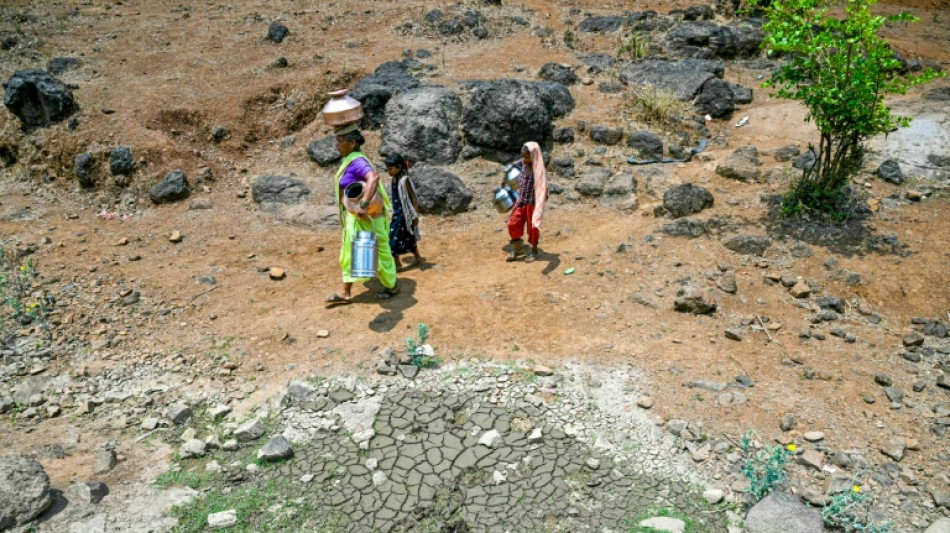
Rural India runs dry as thirsty megacity Mumbai sucks water / Photo: Indranil MUKHERJEE - AFP
Far from the gleaming high-rises of India's financial capital Mumbai, impoverished villages in areas supplying the megacity's water are running dry -- a crisis repeated across the country that experts say foreshadows terrifying problems.
"The people in Mumbai drink our water but no one there, including the government, pays attention to us or our demands," said Sunita Pandurang Satgir, carrying a heavy metal pot on her head filled with foul-smelling water.
Demand is increasing in the world's most populous nation of 1.4 billion people, but supplies are shrinking -- with climate change driving erratic rainfall and extreme heat.
Large-scale infrastructure for Mumbai includes reservoirs connected by canals and pipelines channelling water from 100 kilometres (60 miles) away.
But experts say a failure of basic planning means that the network is often not connected to hundreds of rural villages in the region and several nearby districts.
Instead, they rely on traditional wells.
But demand far outstrips meagre resources, and critical groundwater levels are falling.
"Our days and our lives just revolve around thinking about collecting water, collecting it once, and collecting it again, and again," Satgir said.
"We make four to six rounds for water every day... leaving us time for nothing else".
- Heatwaves and dry wells -
Climate change is shifting weather patterns, bringing longer-lasting and more intense droughts.
Wells rapidly run dry early in the extreme heat.
In the peak of summer, 35-year-old Satgir said she can spend up to six hours a day fetching water.
Temperatures this year surged above a brutal 45 degrees Celsius (113 Fahrenheit).
When the well dries, the village then relies on a government tanker with irregular supplies, two or three times a week.
It brings untreated water from a river where people wash and animals graze.
Satgir's home in the dusty village of Navinwadi, near the farming town of Shahapur, lies some 100 kilometres from the busy streets of Mumbai.
The area is also the source of major reservoirs supplying some 60 percent of water to Mumbai, local government authorities say.
Mumbai is India's second-biggest and rapidly expanding city, with an estimated population of 22 million.
"All that water from around us goes to the people in the big city and nothing has changed for us," Satgir said.
"Our three generations are linked to that one well," she added. "It is our only source."
Deputy village head Rupali Bhaskar Sadgir, 26, said residents were often sick from the water.
But it was their only option.
"We've been requesting governments for years to ensure that the water available at the dams also reaches us," she said. "But it just keeps getting worse."
Government authorities both at the state level and in New Delhi say they are committed to tackling the problem and have announced repeated schemes to address the water crisis.
But villagers say they have not reached them yet.
- 'Unsustainable rates' -
India's government-run NITI Aayog public policy centre forecasts a "steep fall of around 40 percent in freshwater availability by 2030", in a July 2023 report.
It also warned of "increasing water shortages, depleting groundwater tables and deteriorating resource quality".
Groundwater resources "are being depleted at unsustainable rates", it added, noting they make up some 40 percent of total water supplies.
It is a story repeated across India, said Himanshu Thakkar, from the South Asia Network on Dams, Rivers and People, a Delhi-based water rights campaign group.
This is "typical of what keeps happening all over the country", Thakkar said, adding it represents everything "wrong with the political economy of making dams in India".
"While projects are planned and justified in the name of drought-prone regions and its people, most end up serving only the distant urban areas and industries," he said.
Prime Minister Narendra Modi, who began a third term in office this month, announced a flagship scheme to provide tapped water to every household in 2019.
But in Navinwadi village, residents are resigned to living on the strictly rationed supply.
When the water tanker arrives, dozens of women and children sprint out with pots, pans, and buckets.
Santosh Trambakh Dhonner, 50, a daily labourer, said he joined the scramble as he had not found work that day.
"More hands means more water at home", he said.
Ganesh Waghe, 25, said residents had complained and protested, but nothing was done.
"We are not living with any grand ambitions," Waghe said. "Just a dream of water the next morning".
N.Zaugg--NZN