During a heatwave, temperatures not the only threat: expert
/ Photo: THOMAS COEX - AFP/File
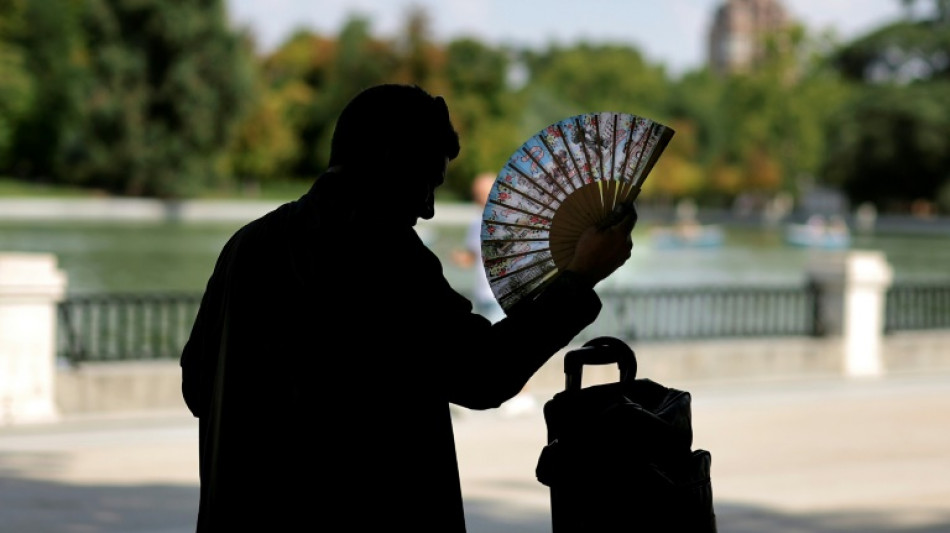
Spain has just emerged from a 21-day heatwave that engulfed Madrid, Barcelona and Zaragoza, posing a health threat which extends far beyond the actual temperature, according to Julio Diaz, a researcher at Madrid's Carlos III Health Institute.
- Isn't heat what kills during a heatwave? -
"The impact of heat on health is far more than just temperature... its effect can be felt across income levels, age groups, socio-economic conditions, healthcare, and different cultural approaches to heat," says Diaz.
"We divided Spain into 182 regions... and in each one, we worked out the temperature at which people start to die as a result of the heat. In Seville, 40 degrees Celsius (104 Fahrenheit) is not even classed as a heatwave, whereas in A Coruna (in northwestern Spain), the temperature which defines a heatwave is 26 degrees.
"When there is a heatwave, only 3.0 percent of mortality is due to heat stroke. Heat kills by aggravating other illnesses."
- Why are the first heatwaves the most deadly? -
"In the first heatwave (of the year) much more people are likely to be susceptible (to death) than the second because it claims the frailest, leaving fewer susceptible people in the second and fewer still in the third... That's why the first heatwave always has a greater impact on mortality. This is what in epidemiology we call the 'harvest effect'."
- Why are living standards a factor? -
"It's clear that the impact of heat is much greater in poorer neighbourhoods.
"It is not the same thing to experience a heatwave in a room with three people and one window and no air conditioning or fan, than going through the same thing in a villa with a swimming pool.
It's not even a question of having air conditioning or not, but about being able to turn it on. During this heatwave, the price of electricity in Spain skyrocketed."
- What is heatstroke? -
"Heatstroke happens when a person is exposed to high temperatures... and their body is not able to regulate that temperature. If you go out in the sun at 42C or exercise at those temperatures, your body is unable -- no matter how much it sweats, which is the main mechanism for regulating heat -- to lower and maintain its temperature at 37C.
When your body is no longer at 37C... your organs stop working properly, including your brain. Then hyperthermia sets in and the person can die."
- What is 'heat culture'? -
"In 2003, Europe suffered a brutal heatwave and 70,000 people died in 15 days. People were not prepared, and there were no prevention plans, which meant it had a brutal impact on mortality. Now nobody doubts that heat kills.
But people adapt. Between 1983 to 2003, for every degree above the temperature classed as a heatwave, the mortality in Spain increased by 14 percent. But after 2003, it barely increased by three percent.
In a city like Madrid, you never used to see older people wearing shorts but nowadays they all wear them -- you see them going out for a walk wearing a hat and with a bottle of water.
In places where they are used to having heatwaves, there are now much more air conditioning units and secondly, homes are much more adapted to cope with this heat.
People don't go out from 3:00 pm, that's why the siesta exists in Spain. And in the southern Andalusia region, the villages are painted white and the streets are wide so the wind can freely circulate."
O.Krasniqi--NZN