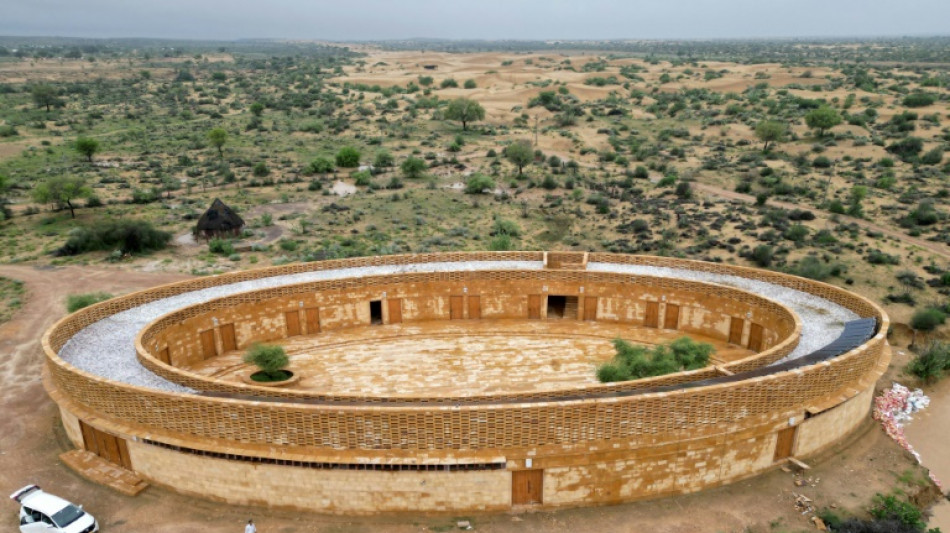
Indian desert school's unique design offers respite from heat / Photo: Idrees MOHAMMED - AFP
In the sweltering heat of India's Thar desert, where summer highs soar above 50 degrees Celsius, an architecturally striking school is an oasis of cool thanks to a combination of age-old techniques and modern design.
The Rajkumari Ratnavati girls' school uses the same yellow sandstone as the 12th-century fort in nearby Jaisalmer, in India's western state of Rajasthan, dubbed the "golden city" due to the colour of the rock.
Like the fort, the school has thick rubble walls that help bounce back the heat, while the interior is plastered with lime, a porous material that regulates humidity and aids natural cooling.
Unlike the ancient fort, its roof is lined with solar panels, which provide all the school's power in an area with frequent electricity cuts.
Temperatures inside the school, designed by US-based architect Diana Kellogg and built by local artisans -- many of them parents of pupils -- can be as much as 20 percent lower than those outside.
"I love going to the school," said eight-year-old Khushboo Kumari, one of the 170 students.
"The air feels as if it is coming from an AC."
The school's classrooms are arranged around an open elliptical courtyard resembling a Roman coliseum, and walls with grids of vents create shade while allowing for cooling airflow.
Elevated windows allow hot air to escape as it rises. Rainwater is harvested from the flat roof.
In some places, the walls are dotted with perforations -- a technique known as "jali" that was traditionally used for modesty, shielding women from view in the conservative society.
At the school, it is used to promote ventilation, creating a breeze channelled by the building's oval shape.
"There is cross-ventilation," said school supervisor Rajinder Singh Bhati, aged 29. "The white tiles on the terrace reflect the sunlight."
"It is totally eco-friendly."
- 'Airy and cool' -
India this year baked in its longest-ever heatwave, according to government weather experts.
Temperatures surged above 50 degrees Celsius (122 degrees Fahrenheit), with warnings people will face increasingly oppressive heat in the future.
Manohar Lal, 32, the father of pupil Khushboo, said students looked forward to class thanks to the relative cool.
"There are frequent power cuts in Rajasthan, and children have to suffer as temperatures touch almost 50 degrees Celsius in summer," Lal said outside his modest home of mud and brick, which does not have a ceiling fan.
"But there are no such worries in the school because it is powered by solar energy," he added.
"It is airy and cool, and that is why the children enjoy going to school".
- 'Feels like heaven' -
The school is supported by the US-based CITTA Education Foundation, meaning pupils attend for free in a state where the literacy rate for women is about 52 percent.
Uniforms, school materials and lunch for pupils are also provided.
"It's a big thing that they are getting quality education free of cost, considering they can't even afford proper meals or clothing," said Hindi teacher Priyanka Chhangani, 40.
Kellogg, the architect, said combining tradition with modern design and sustainable techniques was key.
"Because the craftsmen were so familiar with the stone, we were able to integrate traditional architectural details along with indigenous heritage details, so that the structure felt authentic to the region", she said.
Her oval design was inspired by "feminine symbols of strength", she added.
But while her design focused on tackling baking heat, it also faces an unexpected, climate change-driven problem -- floods.
Intense rainfall during the annual monsoon is common from June to September, but experts say climate change is increasing its frequency and severity.
That increased rainfall has begun to impact the school, which was designed for a drier climate.
This year, a long-dormant river was overflowing, washing away soil at one side of the school.
Rajan Rawal, a professor at India's Centre for Environmental Planning and Technology University, said the increasing intensity of rain was impacting buildings designed for other weather.
"Disasters like heat waves and floods impact the structural stability," Rawal said.
They also affect the thermal performance of the building, he added.
But teacher Chhangani said the school was still changing the lives of the pupils.
"These children don't even have fans at home," she said. "When they come to school, it feels like heaven to them."
P.E.Steiner--NZN