China coal production threatens climate goals: study / Photo: Noel Celis - AFP/File
China's planned expansion of coal mining threatens the country's climate goals and risks vastly increasing its methane emissions, a study warned on Tuesday.
The warning comes as research shows concentrations of the powerful greenhouse gas are rising at an accelerating pace.
China is the world's top emitter of greenhouse gases and remains heavily reliant on coal despite installing renewable energy capacity at record speed.
It aims to peak its planet-warming emissions by 2030 and reach net zero three decades later.
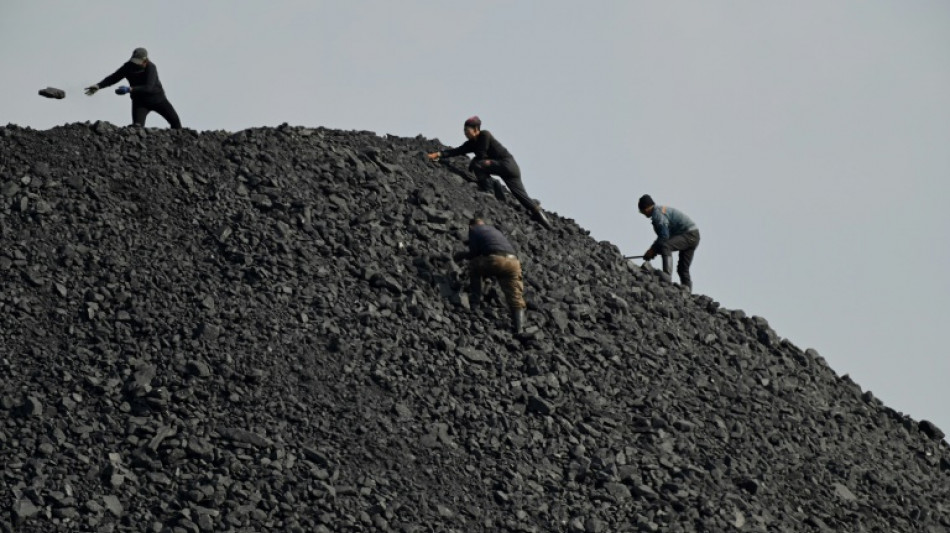
However, it produced a record 4.7 billion tonnes of coal last year, 50 percent of global output, and more is on the way, said NGO Global Energy Monitor (GEM).
In all, China has 1.2 billion more tonnes a year of capacity in development, including new sites and expansions of existing mines, said GEM.
That accounts for more than half the global pipeline.
"If materialised, and without robust mitigation measures, this massive expansion will significantly increase methane emissions," GEM warned.
Carbon dioxide is the primary greenhouse gas produced by human activity, followed by methane which comes mainly from agriculture, energy production and organic waste in landfills.
While it breaks down faster than carbon dioxide, methane is also more potent.
It is also "rising faster in relative terms than any major greenhouse gas and is now 2.6-fold higher than in pre-industrial times", an international group of researchers said in a separate study published in Environmental Research Letters on Tuesday.
- Emissions calculations -
Coal production is a major source of methane, which seeps from mines through vents, open pits and cracks in the ground.
More than 150 countries have signed up to a Global Methane Pledge to cut methane emissions by 30 percent from 2020 levels by 2030.
China, India and Russia have declined to sign.
Calculating methane emissions is complicated, with satellites increasingly being used to monitor hard-to-detect leaks from space.
The International Energy Agency estimated methane emissions from China's coal mines at around 20 million tons in 2023.
But GEM said the real figure could be significantly higher, based on its analysis of nationwide coal mine activity data.
It puts the figure closer to 35 million tonnes and warned that could rise by another 10 million tonnes if all China's projected coal production materialises.
GEM's calculations use data such as coal type and mine depth and an emissions factor that varies according to the mine type.
Where production data is unavailable, the estimates rely on capacity figures, explained the report's co-author Dorothy Mei, "which can result in higher estimated emissions".
The methodology does not factor in mitigation measures because of a lack of data, she told AFP.
China has continued to invest in coal production and power even as it massively expands its renewable capacity.
Analysts say this reflects Beijing's cautious approach to energy security after experiencing power shortages during drought that affected hydropower production.
And GEM noted that China's coal plans include a pool of "idle yet operational" mines that could be mobilised in case of supply disruptions.
Coal power permits in China fell 83 percent in the first half of 2024 and some experts believe the country's emissions may have already peaked.
China and the United States will host a second joint summit on methane and other non-CO2 gases at this year's United Nations climate talks in Baku.
M.J.Baumann--NZN