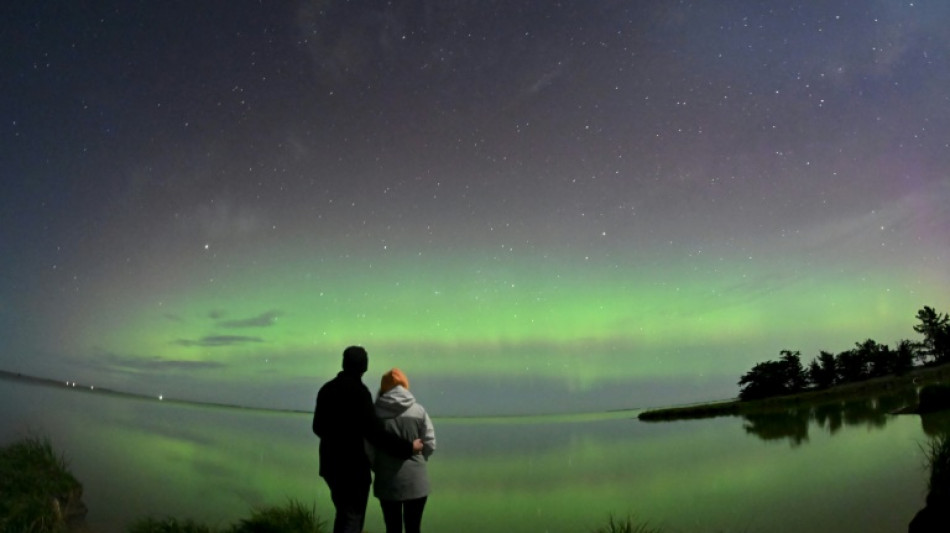
'Party atmosphere': Skygazers treated to another aurora show / Photo: Sanka Vidanagama - AFP
Scientist Jim Wild has travelled to the Arctic Circle numerous times to study the northern lights, but on Thursday night he only needed to look out of his bedroom window in the English city of Lancaster.
For at least the second time this year, skygazers in many parts of the world were treated to colourful auroras at latitudes beyond the polar extremes where they normally light up the skies.
The dazzling celestial shows were caused by a gigantic ball of plasma -- and an accompanying magnetic field -- which erupted from the Sun earlier this week.
When this eruption, called a coronal mass ejection (CME), arrived at Earth at around 1600 GMT on Thursday, it triggered a strong geomagnetic storm.
This storm in turn sparked northern and southern lights -- aurora borealis and aurora australis -- in swathes of Europe, the United States, Australia and elsewhere.
While Wild could see the shimmering reds and greens from his back garden, he jumped in the car with his family to get a better look away from the bright lights of Lancaster.
"All the little back roads and parking spots were full of people with flasks of coffee and deck chairs looking at the northern lights," he told AFP.
"It was a party atmosphere," he said, comparing the scenes to UFO spotters looking up at the sky in the movie "Close Encounters of the Third Kind".
While Wild was explaining the phenomenon to his 11- and 13-year-old children, another nearby skygazer approached and asked how come he knew so much about it.
"Well, actually, this is what I study for a living," responded the professor in space physics at Lancaster University, who specialises in how solar weather disrupts power grids and transport here on Earth.
- 'Perfect hit' -
Auroras were also visible across northern Europe, including near London and Berlin, and as far south in the US as the state of Virginia. In the Southern Hemisphere, areas of Australia and New Zealand were also treated to a show, AFP photos showed.
The CME that triggered Thursday's auroras erupted from a spot on the Sun pointed directly at Earth, said Juha-Pekka Luntama, the head of the European Space Agency's Space Weather Office.
"It was a perfect hit," he told AFP.
The CME caused a "severe" geomagnetic storm given a rating of G4. This fell narrowly short of the highest level of G5, which was seen in May, when auroras delighted many skygazers across swathes of the world.
Storms on the Sun have been intensifying as solar activity approaches -- or may have already reached -- the peak of its 11-year cycle.
While such storms offer pretty light shows for skygazers, they can pose a serious threat to satellites, GPS services, power grids and even astronauts in space.
The US Space Weather Prediction Center warned on Thursday that the geomagnetic storm could disrupt emergencies services already stretched thin by deadly hurricanes Helene and Milton.
Luntama said the European Space Agency had not received any information about disruptions caused by the latest storm, but sometimes this can take days.
The storm is "gradually dissipating", he added, which means that any auroras on Friday night or over the weekend will likely be farther north in Europe, such as central Sweden.
- 'Delighted' -
But for those still hoping to see an aurora, there could be some more chances in the next couple of years.
Luntama explained that during past solar cycles, the biggest eruptions have come in the two years after the Sun passed its peak.
Wild also did not expect a repeat of Thursday's "magical" display.
But space weather -- like Earth's weather -- is not an "exact art," he emphasised.
And if there is an aurora lighting up the sky nearby, it is worth seeking out.
Wild said his neighbours had travelled to Norway twice to see the northern lights -- but had been foiled by clouds both times.
Then on Thursday night, they saw an aurora from their garden.
"They were really delighted to finally have seen it," Wild said.
P.Gashi--NZN