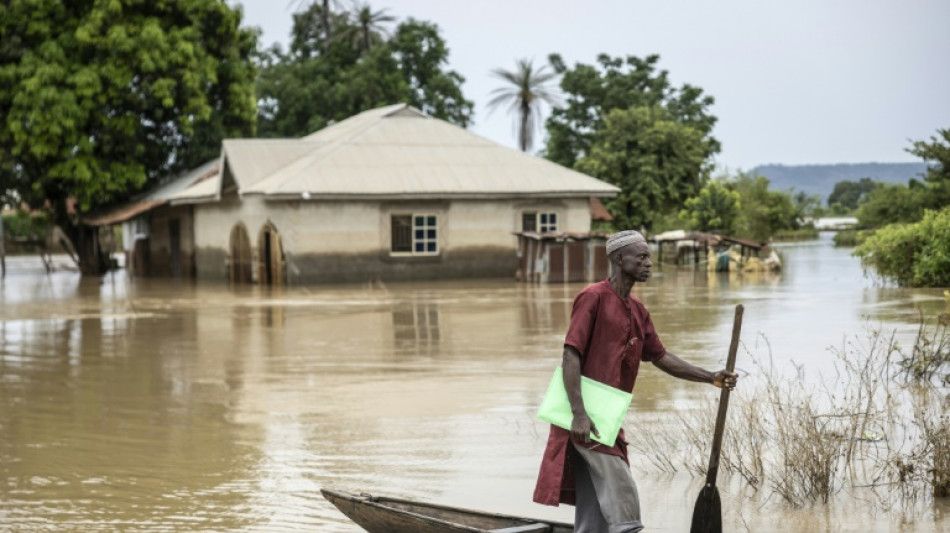
Climate change-worsened floods wreak havoc in Africa / Photo: OLYMPIA DE MAISMONT - AFP
Every rainy season for the past 12 years, floods have swept through 67-year-old Idris Egbunu's house in central Nigeria.
It is always the same story -- the Niger River bursts its banks and the waters claim his home for weeks on end, until he can return and take stock of the damage.
The house then needs cleaning, repairs, fumigation and repainting, until the next rainy season.
Flooding is almost inevitable around Lokoja in Nigeria's Kogi state, where Africa's third-longest river meets its main tributary, the Benue.
But across vast areas of Africa, climate change has thrown weather patterns into disarray and made flooding much more severe, especially this year.
Devastating inundations are threatening the survival of millions of residents on the continent. Homes have been wrecked and crops ruined, jeopardising regional food security.
Torrential rains and severe flooding have affected around 6.9 million people in West and Central Africa so far in 2024, according to data from the United Nations Office for the Coordination of Humanitarian Affairs (OCHA).
- 'Very, very bad' -
Residents and officials around Lokoja said floods first became more severe in Kogi state in 2012 and have battered the area each year since.
In 2022, Nigeria's worst floods in a decade killed more than 500 people and displaced 1.4 million.
Sandra Musa, an emergency agency adviser to the Kogi state governor, believes this year's flooding has not yet reached the level seen in 2022, but warned it was "very, very bad".
"Usually at this time of year the water level drops, but here it's rising again," she told AFP, estimating that the floods have affected around two million people in the state.
Fatima Bilyaminu, a 31-year-old mother and shopkeeper, can only get to her house in the Adankolo district of Lokoja by boat as a result of the waters.
The swollen river rises almost to the windows, while water hyacinths float past the crumbling building.
"I lost everything. My bed, my cushioned chair, my wardrobe, my kitchen equipment," she told AFP.
With no money to rent a house elsewhere, she has little choice but to keep living in the small concrete building and repair it, flood after flood.
- Damage and displacement -
Africa is bearing the brunt of climate change, even though it only contributes around four percent of global greenhouse gas emissions, according to a recent report by the World Meteorological Organisation.
This year is set to overtake 2023 as the world's hottest on record.
"This year has been unusual in terms of the amount of rainfall, with many extreme events, which is one of the signs of climate change," said Aida Diongue-Niang from the UN's Intergovernmental Panel on Climate Change (IPCC).
In the Sahel region bordering the Sahara desert, the volume, intensity and duration of rainfall was "unprecedented," according to Amadou Diakite from the Mali Meteo weather service.
In Niger, some regions recorded up to 200 percent more rain than in previous years, the national meteorological service said. The waters put at risk the historic city centre of Agadez, a UNESCO World Heritage site in the desert north.
Over the border in Chad, torrential rains since July have killed at least 576 people and affected 1.9 million, more than 10 percent of the population, according to a report published by the OCHA.
In neighbouring Cameroon, the UN body said torrential rains had destroyed more than 56,000 homes and flooded tens of thousands of hectares of crops.
Floodwaters swept through the capital Conakry in Guinea, while floods in Monrovia reignited debates over building another city to serve as Libera's capital.
Entire districts of Mali's capital Bamako were submerged, leaving waste and liquid from septic tanks seeping across the streets.
In August, downpours caused the roof of the centuries-old Tomb of Askia in the Malian city of Gao to collapse.
Several countries have postponed the start of the school year as a result of the floods.
- 'Keep getting worse' -
"It used to be a decadal cycle of flooding, and we're now into a yearly cycle," said Clair Barnes, a researcher at the Centre for Environmental Policy at Imperial College London.
"This is only going to keep getting worse if we keep burning fossil fuels," she said.
As global temperatures rise, extreme weather events will increase in frequency and intensity, scientists warn.
Experts estimate that by 2030, up to 118 million Africans already living in poverty will be exposed to drought, floods and intense heat.
Building along riverbanks also poses a risk, Youssouf Sane of Senegal's meteorology agency said, urging governments to think about the relationship between climate change and urbanisation.
But the IPCC's Diongue-Niang said the only way to tackle extreme weather was to limit greenhouse gas emissions.
"That doesn't fall to the region -- it falls to the whole of humanity," she said.
O.Hofer--NZN