Future of deep-sea mining stands at a crucial juncture / Photo: ERNESTO BENAVIDES - AFP
Torn between the defenders of the world's seabeds and industrialists eager to exploit the vast, untapped resources of the deep, the international community faces a crucial year that could decide the future of mining in the high seas.
"It feels like a real crunch point," Louisa Casson of Greenpeace International told AFP.
"We are seeing surging momentum for a moratorium (on deep-sea mining). But at the same time, the industry is saying 2025 is the year when we're just going to start applying to mine."
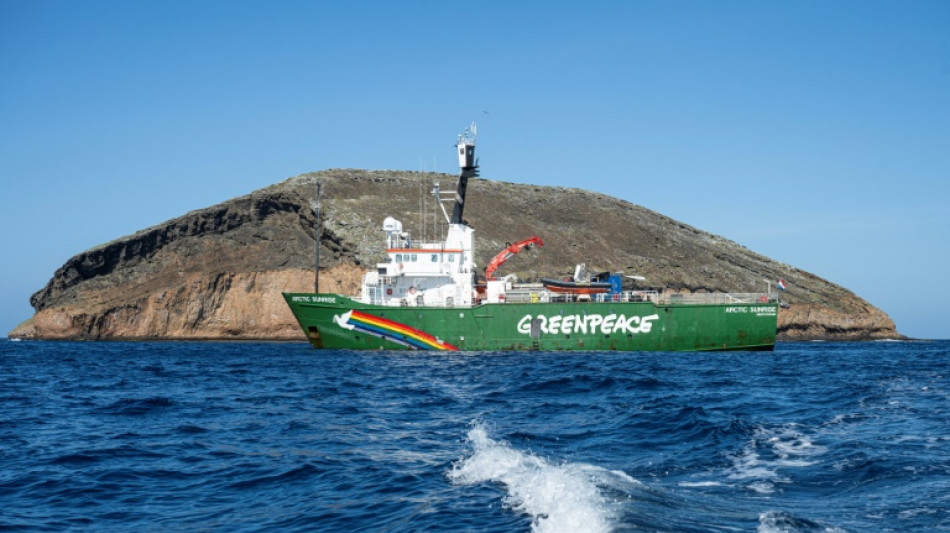
Greenpeace has warned for years of the risks posed by deep-sea mining to the oceans' unique, but only partly understood, ecosystems.
Until recently, the idea of plunging deep into ocean abyss for the large-scale extraction of coveted minerals like cobalt, nickel and copper seemed a distant possibility.
The world paid little attention when the International Seabed Authority (ISA), created under UN aegis in 1994, quietly began negotiating a "mining code" -- rules for the future extraction of seabed resources in international waters.
But the calendar has taken on urgency.
Since July 2023, due to a legal clause invoked by the tiny Pacific island nation of Nauru, any country can apply for a mining contract in the name of a company it sponsors.
And Nauru Ocean Resources Inc. (NORI), a subsidiary of Canada's The Metals Company (TMC), hopes to be the first to benefit from this by mining polymetallic nodules in the Pacific as soon as 2026.
"We... recognize the responsibility that comes with submitting the world's first application of this kind," said TMC's chief executive, Gerard Barron.
He spoke even as the company acknowledged to shareholders that "there can be no assurance that the ISA will provisionally approve our plan ... within one year from submission thereof, or at all."
The company, citing the growing need for these metals amid a global energy transition, has announced that "in close consultation" with Nauru it will file its application on June 27.
That date, the TMC said, was pushed back to allow the ISA Council time to "clarify" the issue during a meeting in March.
The Council, the ISA's executive organ, has yet to agree on the criteria for evaluating applications given the continuing lack of an agreed "mining code."
- 'Political will' -
To fill that void, the Council has laid out a roadmap for adopting a code in 2025.
But thorny issues have yet to be resolved, including environmental rules and how to share the profits from seabed resources that have been dubbed a "common heritage of mankind."
"The code is well advanced, so with political will and a lot of intersessional work, it is possible to finalize it in 2025," one ambassador to the ISA, who requested anonymity, told AFP.
The ambassador then added: "But I don't see that political will. Countries pushing for a moratorium don't have any incentive to be flexible."
Some observers also fear that a rush to finalize matters could result in some ill-conceived rules.
Clement Chazot of the International Union for Conservation of Nature (IUCN) said negotiators are still "very far from achieving a robust text dealing with the potential risks," a failure that could help "buy time."
That time could be used to strengthen the coalition of roughly 30 countries favoring a moratorium on deep-sea mining.
That group failed in 2024 to persuade a majority of the ISA's 169 members to move toward a pause, but conservation-minded NGOs hope to build support in 2025.
For now, most member states have staked out a middle-ground position: working to negotiate sufficiently strong rules to allow mining, while doing as much as possible to protect the environment.
Researchers and NGOs have long warned of the danger of the destruction of habitats and of species that may still be unknown to science -- but which could play crucial roles in deep ocean ecosystems.
Their warnings gained strength this year with the surprise discovery that oxygen was being released on the ocean floor not just by living organisms, but by polymetallic nodules -- a finding rejected by the TMC, though it had helped fund the research.
Whatever the ISA decides, there is nothing to prevent governments from doing as they like in their own territorial waters -- as Norway has done with a plan to open some of its seabeds to prospecting.
G.Kuhn--NZN