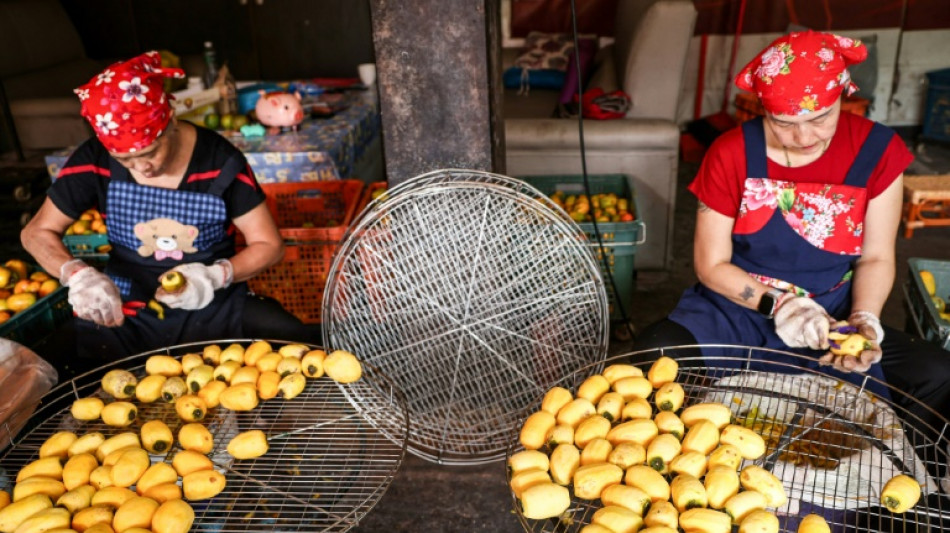
Blooming hard: Taiwan's persimmon growers struggle / Photo: I-Hwa CHENG - AFP
Taiwanese persimmon farmer Lo Chih-neng stands on a ladder in his sprawling orchard using secateurs to cut the golden-yellow fruit still hanging from branches after enduring a tough season.
Persimmons are popular in Taiwan where people travel hours to buy bags and boxes of the sweet dried fruit to take home to their families or give away to friends.
But changing weather and an ageing population are posing a threat to the century-old industry, forcing some farmers to look at alternative ways to maximise returns -- or get out altogether.
Lo's harvest was down by more than a third in 2024, Taiwan's hottest year on record, after some of his trees failed to bloom and two typhoons in October stripped many of their leaves and fruit.
"The yield has dropped by quite a lot, at least a third or more," Lo, 65, told AFP on his farm where persimmon trees carpet a valley in Dongshi district, in the central west of the island.
"The losses have been severe, and it's mostly due to the typhoons," said Lo, who expects to lose Nt$1 million ($30,000) from his takings on this year's crop.
Taiwan's Central Weather Administration said Tuesday that 2024 was the hottest year since records began 127 years ago, echoing unprecedented temperature highs felt around the world.
- Climate hardship -
Taiwan's annual persimmon harvest declined for the second year in a row in 2023 to around 59,000 tonnes.
It is expected to be more than 13 percent lower in 2024, figures from the Agriculture and Food Agency show.
The land area used for growing the fruit has shrunk to 4,700 hectares (11,600 acres) from more than 5,300 hectares a decade ago, and the number of persimmon farmers has also fallen, Su Tang-chao, director of the agency's fruit and flower division, told AFP.
"In recent years, we have observed changes in production areas and fluctuations in yield and quality due to broader environmental changes, such as climate change and global warming," Su said.
Fresh persimmons are harvested from September to December, with most of the fruit sent to Hsinchu county, south of Taipei, to be dried.
Nearly all of the fruit harvested every year is consumed in Taiwan.
Lo's harvest is put into plastic crates, loaded into the back of a truck and taken to Weiweijia persimmon orchard where Lu Li-chien's family has been growing and drying the fruit for more than a century.
Tourists flock to Lu's farm to pose for photos among outdoor circular racks of fruit that shrivel and darken as they dry in the sun and wind -- a traditional method used by Taiwan's ethnic Hakka community.
Normally, fresh persimmons arrive at the Weiweijia farm every day, but Lu said this year's harvest has been "extremely low" and deliveries have been every two days.
"Compared to previous years, we only have about 20 percent of the usual supply," Lu, 68, told AFP.
"When I ask the farmers about the cause, they said the trees are not blooming properly, the flowers aren't opening up as they should."
Lu blames "climate abnormalities", with the production problems worsened by ageing growers whose children have no interest in taking over the family orchard.
"We've never encountered such a situation," he said of the poor harvest.
To maximise earnings, Lu's workers collect persimmon peels and turn them into dye. There are also plans afoot to make skincare products.
Lo, who has a teenage daughter, said he hopes to pass his farm to his nephew in the next few years -- if he is up to the challenge.
"I told him, 'If you're afraid of hardship, you won't be able to do this'," Lo said. "It gets really hot sometimes, and other times, it's very cold."
T.Gerber--NZN