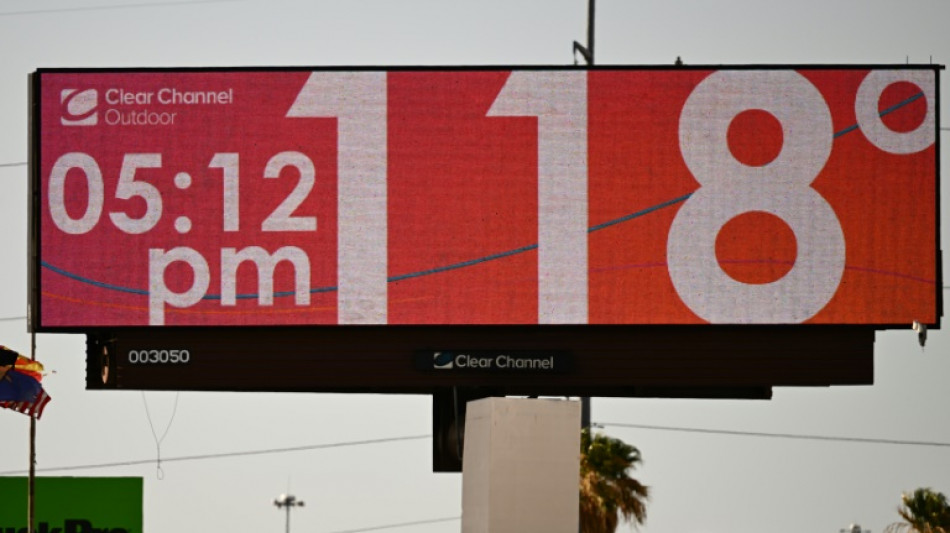
Major climate-GDP study under review after facing challenge / Photo: Patrick T. Fallon - AFP/File
A blockbuster study published in top science journal Nature last year warned that unchecked climate change could slash global GDP by a staggering 62 percent by century's end, setting off alarm bells among financial institutions worldwide.
But a re-analysis by Stanford University researchers in California, released Wednesday, challenges that conclusion -- finding the projected hit to be about three times smaller and broadly in line with earlier estimates, after excluding an anomalous result tied to Uzbekistan.
The saga may culminate in a rare retraction, with Nature telling AFP it will have "further information to share soon" -- a move that would almost certainly be seized upon by climate-change skeptics.
Both the original authors -- who have acknowledged errors -- and the Stanford team hoped the transparency of the review process would bolster, rather than undermine public confidence in science.
Climate scientist Maximilian Kotz and co-authors at the renowned Potsdam Institute for Climate Impact Research (PIK), published the original research in April 2024, using datasets from 83 countries to assess how changes in temperature and precipitation affect economic growth.
- Influential paper -
It became the second most cited climate paper of the year, according to the UK-based Carbon Brief outlet, and informed policy at the World Bank, International Monetary Fund, US federal government and others. AFP was among numerous media outlets to report on it.
Yet the eye-popping claim that global GDP would be lowered by 62 percent by the year 2100 under a high emissions scenario soon drew scrutiny.
"That's why our eyebrows went up because most people think that 20 percent is a very big number," scientist and economist Solomon Hsiang, one of the researchers behind the re-analysis, also published in Nature, told AFP.
When they tried to replicate the results, Hsiang and his Stanford colleagues spotted serious anomalies in the data surrounding Uzbekistan.
Specifically, there was a glaring mismatch in the provincial growth figures cited in the Potsdam paper and the national numbers reported for the same periods by the World Bank.
"When we dropped Uzbekistan, suddenly everything changed. And we were like, 'whoa, that's not supposed to happen,'" Hsiang said. "We felt like we had to document it in this form because it's been used so widely in policy making."
The authors of the 2024 paper acknowledged methodological flaws, including currency exchange issues, and on Wednesday uploaded a corrected version, which has not yet been peer-reviewed.
"We're waiting for Nature to announce their further decision on what will happen next," Kotz told AFP.
He stressed that while "there can be methodological issues and debate within the scientific community," the bigger picture was unchanged: climate change will have substantial economic impacts in the decades ahead.
- Undeniable climate impact -
Frances Moore, an associate professor in environmental economics at the University of California, Davis, who was not involved in either the original paper or the re-analysis, agreed. She told AFP the correction did not alter overall policy implications.
Projections of an economic slowdown by the year 2100 are "extremely bad" regardless of the Kotz-led study, she said, and "greatly exceed the costs of reducing greenhouse gas emissions to stabilize the climate, many times over."
"Future work to identify specific mechanisms by which variation in climate affects economic output over the medium and long-term is critical to both better understand these findings and prepare society to respond to coming climate disruption," she also noted.
Asked whether Nature would be retracting the Potsdam paper, Karl Ziemelis, the journal's physical sciences editor, did not answer directly but said an editor's note was added to the paper in November 2024 "as soon as we became aware of an issue" with the data and methodology.
"We are in the final stages of this process and will have further information to share soon," he told AFP.
The episode comes at a delicate time for climate science, under heavy fire from the US government under President Donald Trump's second term, as misinformation about the impacts of human-driven greenhouse gases abounds.
Yet even in this environment, Hsiang argued, the episode showed the robust nature of the scientific method.
"One team of scientists checking other scientists' work and finding mistakes, the other team acknowledging it, correcting the record, this is the best version of science."
D.Smith--NZN