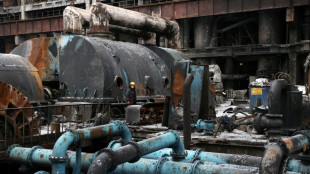
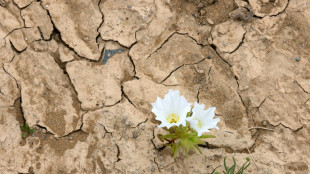
Planetary health check warns risk of 'destabilising' Earth systems / Photo: DAVID GRAY - AFP/File
Humans are gambling the very stability of Earth's life support systems, scientists said Wednesday, warning that ocean acidity was yet another key planetary threshold to be breached.
A team of global scientists assessed that seven of nine so-called "planetary boundaries" -- processes that regulate Earth's stability, resilience and ability to sustain life -- had now been crossed.
Climate change, biodiversity loss, deforestation, freshwater depletion, overuse of agricultural fertilisers, and the release of artificial chemicals and plastics into the environment were all already deep in the red.
In their new report, the scientists said all seven were "showing trends of increasing pressure -- suggesting further deterioration and destabilisation of planetary health in the near future".
Destructive and polluting activities, particularly the burning of fossil fuels, are driving these further into risky territory and increasingly interacting with each other.
"We are putting the stability of the entire life support system on Earth at risk," said Johan Rockstrom, Director of the Potsdam Institute for Climate Impact Research (PIK) in a press conference to launch the research.
The concept of planetary boundaries was first coined in 2009 when only global warming, extinction rates, and nitrogen levels had transgressed their limits.
"We are moving even further away from the safe operating space, risking destabilising our Earth and with an increasing risk growing year by year," said Levke Caesar, co-lead of Planetary Boundaries Science at PIK.
Many of the causes of deterioration are interlinked, showing both the wide-ranging impact of human activities, but also avenues for action.
The use of fossil fuels is a key example, driving climate change, as well as fuelling plastic pollution and the rise in ocean acidification.
- Safety net 'unravelling' -
The world's seas are estimated to have absorbed roughly 30 percent of the excess carbon dioxide released into the atmosphere from the burning of oil, gas and coal.
This alters the pH of the ocean, affecting the ability of organisms like corals, shellfish and some forms of plankton to form shells and skeletons.
Increased ocean acidification since last year's report was partly due to better data and revised calculations.
Scientists said there was already evidence of shell damage, particularly for marine animals in polar and coastal regions.
"What we see in the data is no longer abstract. It is showing up in the world around us right now," said Caesar.
One positive in this year's report is an improvement in global air quality as aerosol emissions fall across the world, despite the continued scourge of severe particulate pollution in some regions.
The final boundary -- ozone depletion -- remains comfortably within safe bounds, which scientists said shows the success of global cooperation to restrict ozone-depleting pollutants.
Researchers have quantified safe boundaries for these interlocking facets of the Earth system, which feed off and amplify each other.
For climate change, for example, the threshold is linked to the concentration of heat-trapping carbon dioxide (CO2) in the atmosphere.
This hovered close to 280 parts per million (ppm) for at least 10,000 years prior to the industrial revolution and researchers suggest the boundary is 350 ppm. Concentrations in 2025 are 423 ppm.
The assessment of the world's biodiversity and ecosystems is even more perilous.
"Nature's safety net is unravelling: Extinctions and loss of natural productivity are far above safe levels, and there is no sign of improvement," the report said.
M.J.Baumann--NZN