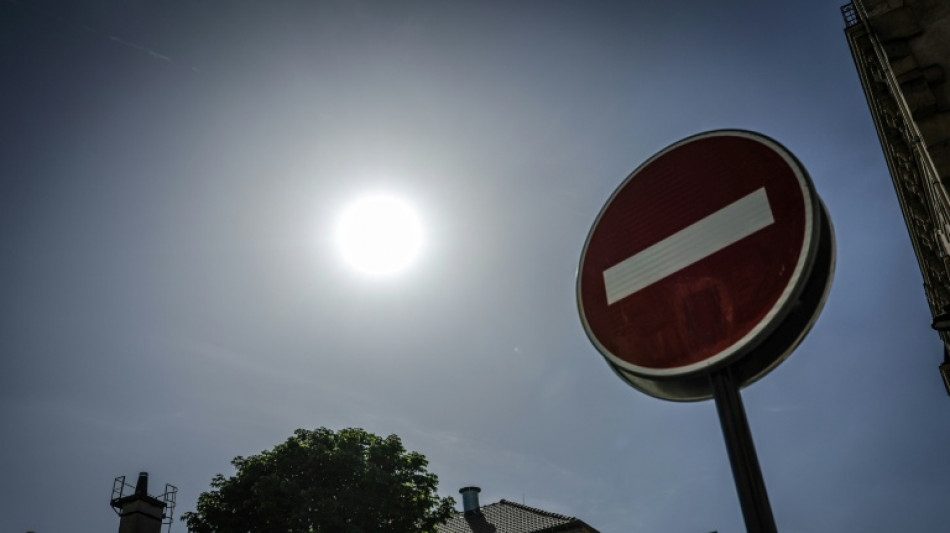
Why is Europe the world's fastest warming continent? / Photo: STEPHANE DE SAKUTIN - AFP
Europe, which is in the throes of a record-smashing heatwave this week, is the world's fastest-warming continent and stretches into an even more rapidly heating Arctic.
After record high temperatures for May were broken in Britain, Ireland and France on Monday and Tuesday, the continent still faces more brutal heat in the coming days.
A so-called "heat dome" of warm air from northern Africa trapped under a high-pressure system over western Europe is behind the sort of heat not usually seen until high summer.
Here is a look at why Europe is warming faster than elsewhere:
- A higher degree -
The planet is around 1.4C warmer than in preindustrial times, defined as 1850-1900.
By comparison, Europe is around 2.4 hotter than the preindustrial era, according to the EU's Copernicus Climate Change Service.
"Almost all of this heat is driven by the human-induced greenhouse effect from fossil fuel emissions, with the actual distribution of this excess heat determined by (several) factors," Ben Clarke, researcher in extreme weather and climate change at Imperial College London, told AFP.
- Changing weather patterns -
Shifts in atmospheric circulation have driven more frequent and more intense heatwaves in the European summer, according to Copernicus.
High-pressure systems, which bring settled weather and higher temperatures, have become more common in Europe, Copernicus Director Carlo Buontempo said.
"If you look over the last 20, 30 years, there has been a prevalence, especially in summer, of those sort of anticyclonic conditions that are making heatwaves more likely," Copernicus Director Carlo Buontempo told AFP.
Whether the increased frequency of that specific type of high-pressure system is due to climate change or is just a "statistical fluctuation" is still a scientific debate, Buontempo said.
Such high-pressure systems are also known as "blocking highs" as they can remain stationary and stop other weather systems from moving into a region.
Explaining how they work, Mary Bourke, geography professor at Trinity College Dublin, told AFP: "The sky is exposed to us, there are no clouds. It's a stable mass of air that is bringing warm air down to the surface and taking away moist air, so the air is not only warm, but it's also dry."
- Rapidly warming Arctic -
Another major reason is geography.
"Europe is connected to the Arctic, which is warming much faster than the rest of the planet," Clarke said.
The Arctic is 3.2C warmer than in preindustrial times, according to Copernicus.
The region's rising temperatures are partly due to a process known as the albedo feedback.
Bright snow and ice reflect much of the sun's heat back into space, but as they melt they reveal darker, heat-absorbing surfaces such as land and the ocean.
"So as sea ice melts it leads to greater absorption of heat, which in turn further warms waters and melts more ice," Clarke said.
- Melting snow -
In other parts of Europe, the area where snow was very frequent in winter has shrunk, Buontempo said.
"We have many of the historical regions that had a week or more of freezing condition now, not having that. And this means exposing dark land rather than white snow," he said.
- Falling air pollution -
Stricter air quality regulations have reduced aerosol emissions since the 1980s.
But tackling the pollutant had the side effect of contributing to global warming, as these tiny airborne particles have a cooling effect by reflecting sunlight and making clouds more reflective.
"While a reduction in air pollution is hugely important for respiratory health, it also increases the solar radiation at the surface, as many types of particulate matter deflect sunlight," Clarke said.
- Varying degrees -
The rate of temperature change varies across Europe.
Eastern and southeastern Europe, and parts of central Europe including the Alps, have warmed by 0.5C-1C per decade over the last 30 years, according to Copernicus.
Western and southwestern Europe, and sub-Arctic Finland, Norway and Sweden, warmed by 0.2C-0.5C per decade.
Svalbard, a Norwegian Arctic archipelago that is home to polar bears, has reached warming of 1.5C-2C per decade.
One of the fastest-warming places on Earth, Svalbard had record high summer temperatures from 2022 to 2024. Last year it saw its fourth warmest summer on record.
T.L.Marti--NZN