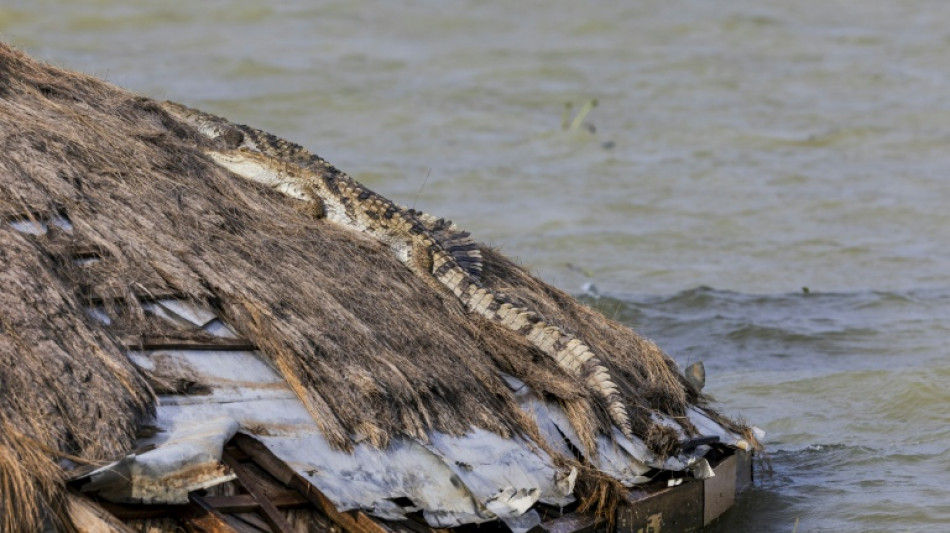
Rising Kenyan lakes push crocodiles closer to homes / Photo: Tony KARUMBA - AFP
A crocodile basks in the sunshine on the roof of a submerged conference hall at a holiday resort in central Kenya, in a visible sign of how rising lake waters are endangering thousands of families and local businesses.
Lake Baringo and other lakes in Kenya's Rift Valley have risen to levels not seen in at least half a century, with scientists attributing the surge to extreme rainfall linked to climate change.
Tens of thousands of people have been displaced to higher ground, according to official data, yet many victims say the lakes keep following them.
In 2011, when the lake recorded its first significant surge, Mary Milka Tiren, 40, lost her husband after a hippo attacked him on his way home from his job at a popular tourist resort, which is now completely submerged.
A decade later, her nine-year-old son spent three months in hospital after a crocodile attack, leaving a scar on his right arm.
"It wanted to rip off his whole arm from the shoulder... but he was rescued by his peers after a long struggle," Tiren said.
"We've seen a rise in crocodile attacks not because there are more crocodiles, but because the lake is now close to the homesteads," Kenya Wildlife Service (KWS) senior warden Jackson Komen told AFP.
"We also have hippo attacks because when the lake expanded, the riparian ecosystem -- where we used to have pasture -- was lost."
- 'Ecological disaster' -
An AFP analysis of Copernicus Sentinel and NASA Landsat satellite imagery shows Lake Baringo's surface area has expanded by 70 percent since 2010, from about 138 square kilometres (53 square miles) to 234 square kilometres.
Neighbouring Lake Bogoria, which is notable for its high sodium levels, has also grown by 21 percent over the same period, increasing from 34 to 41 square kilometres.
As the waters of the two lakes -- one freshwater and the other alkaline -- rise, the distance between them has narrowed.
"If the two lakes mix, then the fish, crocodiles and hippos may not survive... we may have an ecological disaster that we don't know how to deal with," said Komen.
Lake Baringo provides vital drinking and irrigation waters, and supports a thriving fishing industry.
"It may trigger a complete change... I don't know whether human beings will still be able to live here," Komen said.
The distance between the two lakes is now estimated to be about 10 kilometres (six miles).
Scientist Mathew Herrnegger, of Austria's University of Natural Resources and Life Sciences, said "the overflow is already happening".
"Satellite altimetry shows that the lake level of Bogoria is high enough that it overflows towards Baringo," he said.
But how much water will reach Baringo and what impact it will have is unclear, he added.
- Tourism decline -
The expansion of the two lakes has also dealt a major blow to tourism.
"We lost 80 percent of our community wildlife conservancies," Komen said, with giraffes, ostriches, warthogs and impalas all moved to safety.
AFP saw at least four holiday resorts engulfed by Lake Baringo's waters, another stranded and abandoned on an island.
At Lake Bogoria, known for its flamingoes and hot springs, rising waters have driven away a significant number of the birds and submerged some of the springs.
Michael Baimet, the director at the local disaster department, said tourism earnings had dropped from roughly $1 million annually to $200,000.
Google reviews show visitors complaining about dwindling flamingos at Lake Bogoria and impassable roads caused by rising water levels.
- 'Risky' -
Schools have not been spared the devastation.
Official records show roughly 12 institutions around Lakes Baringo and Bogoria have been affected, some completely submerged.
About 240 students and staff at Kokwa Island Primary and Junior School in Marigat must now cross crocodile-infested Lake Baringo, with the lone ferry's multiple trips cutting into learning time.
Most exposed is the girls' dormitory, inches from the lapping waves.
"It is too risky for the girls who board as hippos and crocodiles come into the school at night," said one school official.
"We've been forced to employ two security officers to keep the students safe."
The school fears El Nino rains expected in October could engulf the dormitory.
Families on the same island know they have to relocate as the waters advance -- but finances remain a major issue.
Faith Mpayei, 40, has moved the fence around her once two-acre (0.8-hectare) farm twice since 2016, when she says the lake began advancing rapidly.
Her fence now lies submerged, while the water stands nearly a third of the way up her house.
"It has reduced me to zero," said the mother-of-five.
"We are helpless... I am here just for the time being, I have to relocate... there's nothing left to do here."
M.J.Baumann--NZN