Zürcher Nachrichten - Panama Canal considering more cuts in transits due to El Nino

EUR -
AED 4.268357
AFN 76.142948
ALL 92.050313
AMD 422.869922
ANG 2.080171
AOA 1066.943234
ARS 1756.965801
AUD 1.610654
AWG 2.092046
AZN 1.976378
BAM 1.954728
BBD 2.340017
BDT 142.701744
BGN 1.971597
BHD 0.438064
BIF 3476.123644
BMD 1.162248
BND 1.471006
BOB 14.494114
BRL 5.958377
BSD 1.161873
BTN 109.714306
BWP 15.555603
BYN 3.57324
BYR 22780.053692
BZD 2.336619
CAD 1.605756
CDF 2649.924737
CHF 0.940719
CLF 0.027508
CLP 1086.155915
CNY 7.800194
CNH 7.798054
COP 3624.411145
CRC 527.315364
CUC 1.162248
CUP 30.799562
CVE 110.205039
CZK 24.191485
DJF 206.554702
DKK 7.474992
DOP 68.772878
DZD 154.790017
EGP 59.181065
ERN 17.433715
ETB 188.400404
FJD 2.549448
FKP 0.859755
GBP 0.858326
GEL 3.027647
GGP 0.859755
GHS 13.215809
GIP 0.859755
GMD 86.00583
GNF 10212.663108
GTQ 8.869174
GYD 243.06775
HKD 9.111615
HNL 31.172174
HRK 7.53439
HTG 151.937986
HUF 363.295144
IDR 20553.187219
ILS 3.498888
IMP 0.859755
INR 109.909401
IQD 1521.965372
IRR 1597625.602667
ISK 140.41107
JEP 0.859755
JMD 184.510404
JOD 0.823977
JPY 179.409218
KES 150.441598
KGS 101.638331
KHR 4704.460608
KMF 492.792618
KPW 1046.023215
KRW 1563.792187
KWD 0.358995
KYD 0.968169
KZT 527.730599
LAK 26036.505958
LBP 104040.345524
LKR 381.172448
LRD 203.319377
LSL 18.575473
LTL 3.431815
LVL 0.703032
LYD 7.385014
MAD 10.903867
MDL 20.069994
MGA 4975.314405
MKD 61.491279
MMK 2440.417897
MNT 4180.641194
MOP 9.382455
MRU 46.672807
MUR 54.497585
MVR 17.968293
MWK 2014.612544
MXN 19.664811
MYR 4.70249
MZN 74.266838
NAD 18.574914
NGN 1536.317256
NIO 42.757656
NOK 10.772594
NPR 175.543245
NZD 1.979035
OMR 0.446883
PAB 1.161763
PEN 3.897862
PGK 5.162169
PHP 72.884444
PKR 322.667229
PLN 4.310021
PYG 6921.204495
QAR 4.223202
RON 5.250914
RSD 117.345195
RUB 99.883403
RWF 1713.674986
SAR 4.365225
SBD 9.298576
SCR 16.036208
SDG 699.091581
SEK 11.157902
SGD 1.471255
SHP 0.86107
SLE 28.64874
SLL 24371.750933
SOS 663.941615
SRD 43.868461
STD 24056.179525
STN 24.486782
SVC 10.165425
SYP 15111.543672
SZL 18.571975
THB 38.202755
TJS 10.729362
TMT 4.067867
TND 3.390955
TOP 2.798413
TRY 56.288124
TTD 7.886675
TWD 36.633929
TZS 3073.599016
UAH 51.640325
UGX 4391.610586
USD 1.162248
UYU 46.764556
UZS 13697.488462
VES 937.209875
VND 30241.683524
VUV 137.10706
WST 3.159124
XAF 655.603116
XAG 0.017566
XAU 0.000264
XCD 3.141032
XCG 2.093852
XDR 0.821769
XOF 655.603116
XPF 119.331742
YER 275.452093
ZAR 18.587355
ZMK 10461.621664
ZMW 22.277783
ZWL 374.243265
  • CMSD

    -0.0700

    20.69

    -0.34%

  • CMSC

    -0.1100

    20.81

    -0.53%

  • RIO

    0.4300

    103.27

    +0.42%

  • RBGPF

    0.0000

    70

    0%

  • RELX

    -1.1400

    35.51

    -3.21%

  • VOD

    0.3200

    16.9

    +1.89%

  • RYCEF

    0.1400

    19.92

    +0.7%

  • NGG

    -0.0500

    78.12

    -0.06%

  • BCE

    -0.1400

    23.67

    -0.59%

  • BCC

    2.0900

    79.21

    +2.64%

  • JRI

    -0.0700

    12.14

    -0.58%

  • GSK

    -0.9800

    49.89

    -1.96%

  • BTI

    -0.6200

    55.35

    -1.12%

  • BP

    0.2300

    43.81

    +0.52%

  • AZN

    -2.0700

    162.7

    -1.27%

Panama Canal considering more cuts in transits due to El Nino
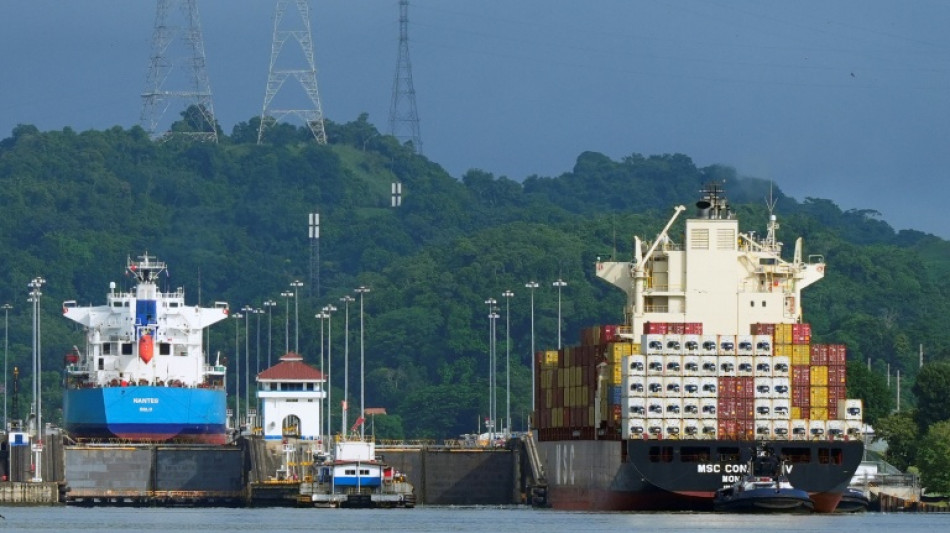
Panama Canal considering more cuts in transits due to El Nino / Photo: ARNULFO FRANCO - AFP/File

Panama Canal considering more cuts in transits due to El Nino

The number of ships sailing through the Panama Canal could be cut further due to drought caused by the El Nino weather pattern, the new administrator of the waterway told AFP on Monday.

Text size:

Panama has declared a nationwide emergency over El Nino, a phenomenon developing over the Pacific Ocean that is affecting worldwide weather patterns and pushing up global temperatures.

This year's El Nino is expected to be the strongest since record-keeping began four decades ago.

Panama's restrictions come even as use of the canal has risen: shippers are seeking an alternative to the Strait of Hormuz, which Iran has blocked in retaliation for the war launched by the United States and Israel.

The interoceanic Panama Canal -- which handles five percent of global maritime trade -- has already reduced the maximum number of ships allowed through daily, from 36 last month to 32 by mid-September.

It operates using rainwater that collects in two reservoirs, whose levels have dropped due to the onset of El Nino.

Without water, the locks that lift and lower ships at the start and end of their crossing cannot function.

Ilya Espino de Marotta, who took over as head of the Panama Canal Authority on Monday, told AFP that further measures may be implemented if the drought does not subside.

"We do not rule out the possibility that in February or March we may have to lower the limit -- probably not to 24 slots per day, but it could be reduced to 29 or something similar," she said.

- 200 mn liters per ship -

Each ship requires about 200 million liters of water, which is then discharged into the sea.

In 2023, El Nino forced a reduction in daily transits from 38 to 22 due to the dramatic reduction in reservoir levels.

Espino de Marotta, the first woman ever to head the US-built canal authority, stated, however, that she does not expect restrictions to reach the levels seen that year.

Apart from reducing the number of vessels, canal authorities have also reduced their maximum draft, from 15.2 meters to 14.6 meters (50 feet to 48 feet).

The draft is the vertical distance between the waterline and the lowest point of a ship's hull. It is a measure of how much water is needed for a ship to float safely without running aground.

Experts have warned that long-term restrictions on canal crossings could lead to higher shipping costs and longer waiting times for deliveries.

The United States and China are the main users of the canal, which is the fastest maritime route between the east coast of the United States and China.

The canal connecting the Atlantic and Pacific handles around 40 percent of US container traffic.

The Iran war has pushed up traffic through the channel.

With shipping at a standstill in the Strait of Hormuz, a conduit for a fifth of the world's oil and gas, the Panama Canal has become a fallback route for energy shipments.

L.Muratori--NZN