Hit reality show helps rev up Japan's delinquent youth subculture / Photo: Yuichi YAMAZAKI - AFP
Sporting towering Elvis-style hair and a school uniform modified into a rebellious silhouette, 15-year-old Reona worships Japan's classic bad-boy subculture recently taken global by a hit Netflix dating show.
Japan in the heady 1980s teemed with hot-blooded teens who rebelled against society through dangerous motorcycle rides, school "wars" and full-on street brawls.
Their outlandish fashion and supposed traits such as chivalry have since made them Japan's pop-culture darlings, from anime to film, despite its conformist population's disdain for rule-breakers.
The latest to capitalise on the genre is Netflix, whose recent reality show "Badly in Love" spotlighted Japan's "yankii" (delinquent) culture by starring 11 young men and women, including former "bosozoku" (motorcycle gang) members.
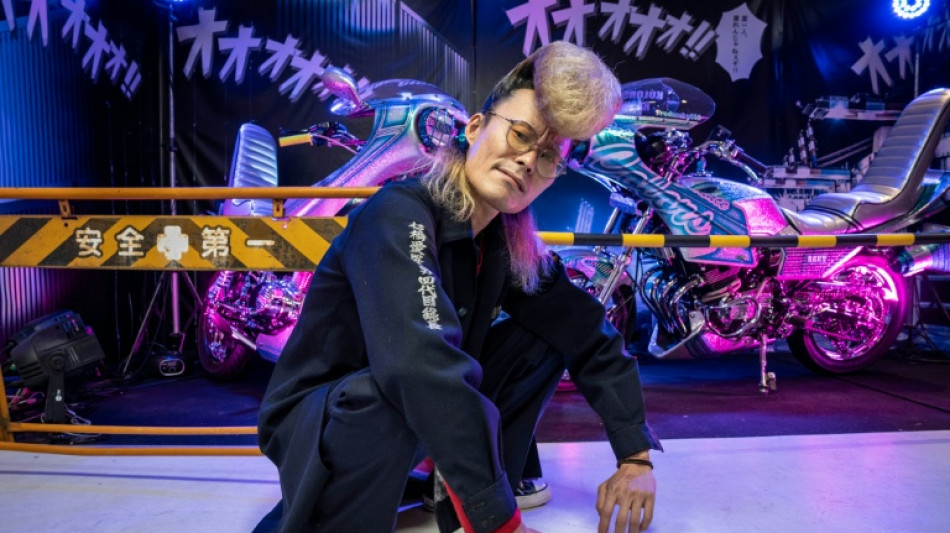
And a yankii-themed exhibition is now underway in Tokyo, re-enacting the 80s chaos with flamboyantly modified motorcycles and heavily embroidered "tokkofuku", military-style jackets worn by the bikers.
High-schooler Reona, who AFP has chosen not to name in full because he's a minor, mimics the 80s rebels by donning baggy school trousers designed to create an imposing impression.
"I think their hardcore manliness on full display is so cool," he told AFP.
A fighting spirit, loyalty to friends and straightforwardness are redeeming qualities often associated with the subculture.
Modern delinquents, meanwhile, are sometimes derided for their childish TikTok clout-chasing, online bullying and the underhanded way they scam elderly people as part of so-called "black-market part-time gigs".
Prank videos have gone viral in recent years showing teenage customers committing unhygienic antics at Japan's famed sushi conveyor-belt restaurants -- so-called "sushi terrorism".
"Getting arrested for riding around your motorcycle may have some honour, but getting arrested for those sushi pranks is plain lame," Reona said.
Hirotaka Sotooka, 43, laughs off his eight-year-old son's precocious penchant for gangster-like attire, but draws a clear line.
The parent is willing to tolerate motorcycles, fistfights and fashion statements, but "I don't want him to bully the weak, be violent toward women or do anything purely evil", he told AFP.
"Otherwise it's his life to enjoy," he said, proudly watching as his son strikes a perfect tough-guy pose before a bosozoku-style bike showcased at the yankii exhibition during its February iteration.
- 'Embarrassing' -
Japanese teens still do make headlines vrooming recklessly, skirmishing or even duelling, but they are now commonly seen as less belligerent after many moved online to vent.
The number of bosozoku members, too, plummeted nearly 90 percent to 5,880 in 2024 from their peak in 1982, police data shows.
That is partly because "surveillance cameras are now everywhere" and "everyone films you on an iPhone and leaves proof of your act", Kenichiro Iwahashi, a former outlaw biker turned delinquency expert, told AFP.
With the risk of arrest much higher, bosozoku gangs as hardcore as those in the 80s known for their unlicensed, unhelmeted and tokkofuku-flaunting style are "almost non-existent today", he said.
While long popular in fiction, yankii youths remain deeply frowned upon in real life for their transgressive behaviours and occasional transitions to full-fledged career criminals.
Satoru Saito, who performs as a "yankii comedian" complete with towering quiff, shaved eyebrows and tokkofuku, sometimes finds himself vilified online by those almost allergic to his "anti-social" appearance.
"For some people, this is a hard no," the 33-year-old told AFP.
"Most of these yankii folks are doing things like fighting or committing crimes, and the act of riding motorcycles at midnight can be extremely noisy, so I get why they are hated."
This makes "Badly in Love" an audacious project that few conventional TV broadcasters would have dared to green light.
From "Tokyo Revengers" to "Crows", manga and movies themed on school gangs have always made popular content as escapist fantasy.
But featuring these troublemakers beyond fiction would have "risked exposing TV stations to criticism from the public that they are endorsing the yankii culture", influential entertainment writer Motohiko Tokuriki told AFP.
Mindful of the risk, Netflix says it went beyond strict legal compliance to "avoid sensationalism" and contextualise cast members' past slips into delinquency.
"We had extensive internal discussions... to ensure the production would not be perceived as glorifying or condoning the violence," "Badly in Love" executive producer Dai Ota told AFP.
Overall, his gamble paid off: the show, with Season 2 already set for release later this year, has maintained a weeks-long top 10 presence, including in South Korea, Taiwan and Hong Kong.
"Our hope was to show that these young people -- who have often been marginalised or labelled as 'social outcasts' -- are simply youths who worry, struggle and genuinely grow."
Despite her tough, heavily tattooed exterior, Season 1 participant Otoha told AFP she is "not at all what people think of me".
The 23-year-old "introvert" now calls her past delinquency "embarrassing".
"I'd like people not to admire us, but take us as their anti-role model."
H.Roth--NZN