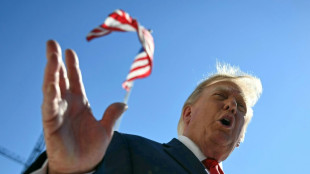
Dizzying month on markets with Middle East war / Photo: Michael M. Santiago - GETTY IMAGES NORTH AMERICA/AFP/File
Oil prices soaring, bond yields climbing and equities slumping... financial markets saw dizzying movements in March thanks to the war in the Middle East.
- Oil prices on fire, stagflation stalks -
The closure of the Strait of Hormuz, through which a fifth of the world's crude transited before the war, sent oil prices skyrocketing.
The price of Brent crude, the benchmark international oil contract, soared nearly 50 percent.
That is a record monthly gain since Bloomberg began compiling data on oil prices in 1988.
WTI, the benchmark US oil contract, closed above the symbolic level of $100 per barrel on Monday. It could see its biggest monthly gain since 2020.
Economist Sylvain Bersinger called it a "mini oil shock".
The surge in oil prices raises the risk of stagflation, a period of high inflation and feeble growth that central banks find difficult to handle, as lowering interest rates to support growth feeds inflation while raising rates provokes a recession.
- Stocks in the red -
Stocks slumped as soaring oil prices are bad for economic growth.
In Europe, where indices were flirting with record levels, pulled sharply lower.
The CAC 40 index in Paris fell 8.9 percent in March, its worst monthly performance since the outbreak of the Covid-19 pandemic in March 2020.
The Stoxx Europe 600 index, which includes the largest companies on the continent, and Frankfurt's DAX, both turned in their worst monthly performance since June 2022.
In Asia, Tokyo fell 13.2 percent and Seoul tumbled 19.1 percent.
Wall Street's main indices were heading towards monthly losses of around seven percent.
- Dollar strengthens -
The dollar strengthened as investors sought it out as a safe haven asset. It gained 2.4 percent versus the euro in March. It had been falling in previous months over concerns about US President Donald Trump's policies.
The dollar also benefitted from being the currency used to trade oil. Higher prices meant countries needed to purchase more dollars to buy oil.
The US economy's self-sufficiency in oil and gas also means it is likely to feel less the consequences of an oil shock.
Some investors "sold all their holdings to move their money to the United States," said Eric Bleines, deputy director at Swiss Life Gestion privee, a wealth management firm.
- Sovereign yields climb -
With inflation set to surge on higher oil prices investors have demanded higher yields on government bonds.
The German 10-year Bund is the reference in the eurozone. It rose to above three percent -- its highest level since 2011 -- compared to 2.7 percent before the war.
The rate on 10-year French government bonds rose above 3.7 percent, hitting levels unseen since 2009, potentially complicating the government's efforts to bring down the budget deficit as debt financing costs rise.
- Volatility -
Markets were also stuck by severe volatility as Trump's zig-zagging positions, sometimes within the same appearance, yanked prices in different directions.
Trump's numerous threats against Iran sometimes prompted investors to make so-called TACO trades -- Trump Always Chickens Out -- betting that the US president would not follow through.
They didn't always pan out as Trump continued to prosecute the war.
"Things can go in any direction, every day," said ING analyst Vincent Juvyns.
He urged investors to keep their cool.
"Historically, over the long term, markets recover following geopolitical shocks," he said.
Ipek Ozkardeskaya at Swissquote Bank said markets will continue to be driven by headlines and movements in oil prices.
"Until there is meaningful progress toward peace, any rebound in equities, bonds or gold is likely to remain fragile," she said.
M.J.Baumann--NZN