'Two bad options': Rights groups decry IMF austerity demand / Photo: ANTHONY WALLACE - AFP
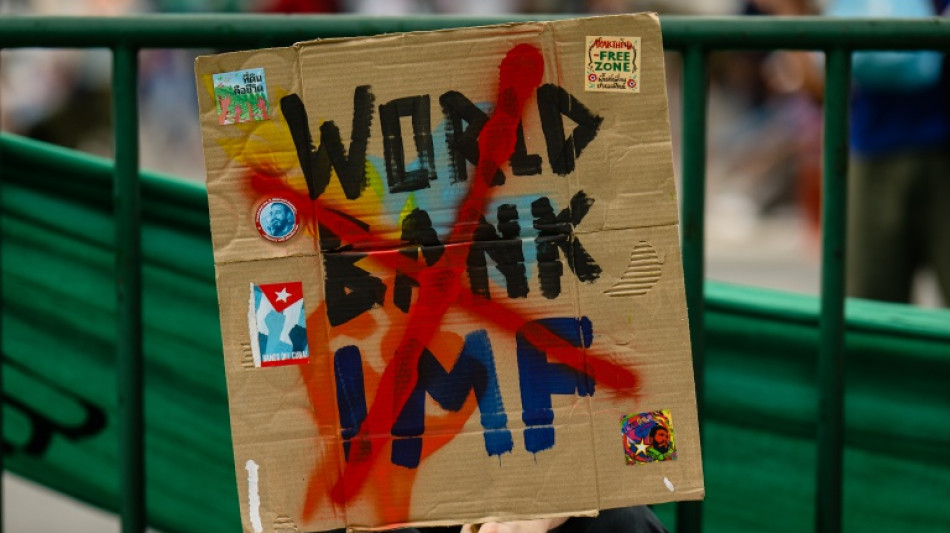
Coconut farmer Sombat Chuekrod travelled more than 200 kilometres to join hundreds on the streets of Bangkok on Friday demanding that the International Monetary Fund and World Bank change how they deal with the developing world.
Finance ministers, central bank governors and other top policymakers gathered this week in the Thai capital for the IMF-World Bank Annual Meetings, as decision-makers tackle an inflation crisis fuelled by the US war on Iran and other economic shocks.
The message from the IMF has been clear: after years of economic crises starting with the pandemic and continuing through the wars in Ukraine and the Middle East, worldwide debt is too high and governments need to cut spending.
For the hundreds at the protest in Bangkok, as well as for rights groups and analysts interviewed by AFP, that message is the wrong one.
"We want the IMF and World Bank to rethink their role," said 51-year-old Sombat, as he walked alongside banners demanding reform of the institutions.
"Thai people are already poor. Please don't make them any poorer."
Protest organisers called on institutions like the IMF to focus on climate financing and tax reforms that aid poorer citizens rather than demand governments cut subsidies and social spending.
"Governments across the Global South are being forced to squeeze vital spending on public health, education, and social protection just to service illegitimate debts to wealthy nations and private creditors," Lidy Nacpil, one of the protest organisers, said in a statement.
- 'Inequality emergency' -
Speaking to AFP on the sidelines of the meetings, Oxfam Executive Director Amitabh Behar said the world was facing an "inequality emergency", and that the IMF's calls for fiscal consolidation were code for cutting spending on essential social support during the war-fuelled inflation crisis.
"It will lead to (more) price rises. It might lead to hunger," he said. "You will see cuts further happening in terms of health, in terms of education, in terms of basic social security.
"So all that is going to suffer in a time when you actually need it more."
The IMF this week upgraded its world economic outlook, citing unexpected "resilience" in economic growth. But it warned that that prosperity was fragmented, with vulnerable countries falling even further behind.
It highlighted oil-importing low-income countries not exposed to the boom in artificial intelligence investment as being the most vulnerable.
Yet the Fund's advice to all countries at a time of rising global debt levels has been to cut spending and rebuild fiscal buffers after years of spending on crises.
Asked what vulnerable countries should do, IMF deputy chief of research Petya Koeva Brooks told AFP that while their situation was indeed "more difficult", they had "no other choice" but to address their fiscal balances by either cutting spending or increasing revenues.
The IMF has proposed making energy and food subsidies offered in the wake of the Iran war more targeted, even as the UN Development Programme warned this week that if such subsidies were cut entirely, it could plunge 130 million people into poverty.
Protest organiser Nacpil questioned in an interview how one could draw a line between who deserves a subsidy and who does not.
"How poor do you have to be for them to think that you will need some support?" she asked.
- Trading off -
Reza Baqir of Alvarez & Marsal's Sovereign Advisory Services said he has experience with the difficult trade-offs policymakers in low-income countries face in such crises.
"During my time as Pakistan's central bank governor, I saw firsthand how difficult it can be for countries to balance the needs of the countries' citizens with the needs of the IMF programme," he said.
"At the same time, it also reinforced the importance of addressing domestic governance challenges, so countries can build their own resources and fiscal buffers, reduce their reliance on the IMF and support their citizens in a targeted and prudent manner."
Christina Segal-Knowles of the Rockefeller Foundation said developing countries are "effectively being given two bad options" -- either take on debt at currently sky-high interest rates, or make extraordinary spending cuts and potentially give up on development goals.
She proposed a "growth and investment reset" that ramps up funding to countries in need as part of a set of measures designed to provide sustained support at concessional rates.
On the streets of Bangkok on Friday, protesters prepared to spend the night under a flyover.
"We are raising our voices because we believe that the network of citizens present here are key stakeholders in the negotiations," said activist Supaporn Malailoy.
"This is not merely a matter of borrowing money; it is about shaping the very structure and direction of the nation's development."
S.Scheidegger--NZN