Middle East fuel crunch drives solar push in tiny Fiji / Photo: Saeed KHAN - AFP
Power cables weave through palm trees high above Fiji's Rukurukulevu Village, linking residents to the national grid and a select few to solar panels.
The settlement of about 400 people finally electrified its last building this year -- a kindergarten, just metres from the sea.
But residents are struggling to keep the lights on as the Middle East war and other factors push up energy bills in this Pacific paradise.
It is challenging Fiji's reliance on imported fossil fuels and driving a push towards renewables in the resource-scarce island nation.
"The prices of electricity here in Fiji (are) very high," village spokesman Vereniki Nalio told AFP.
"Some houses, they got FJ$100 (US$44) and over. The church, community halls and church minister's house, they've got about FJ$200, nearly FJ$300, for a month."
Nalio said he paid about FJ$60 per month for electricity -- "very, very high".
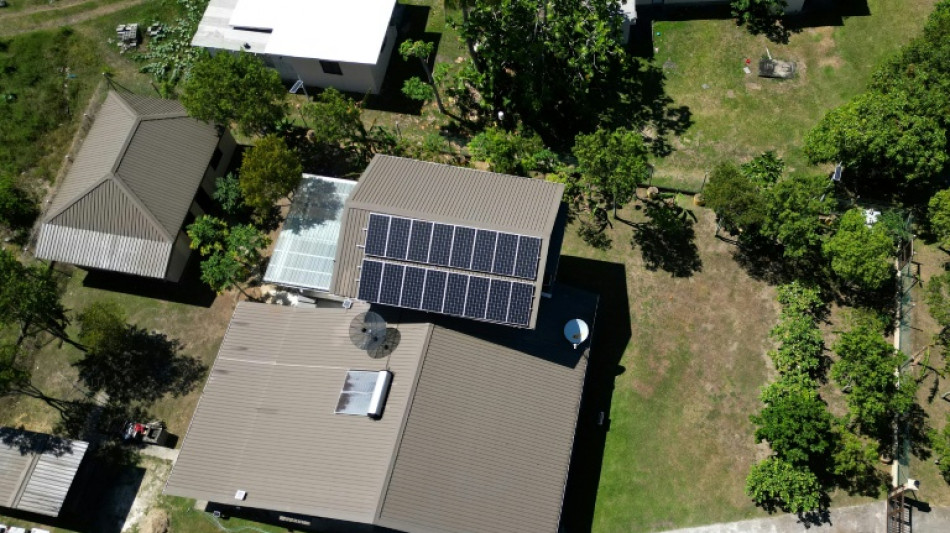
Opposite his home stands another small house with one big difference: past the clothes hanging on the washing line lies a small array of solar panels.
Another home across the road boasts an even larger installation, showing how some in the village are seeking to move away from dependence on the grid.
Since the United States and Israel attacked Iran in February, fuel shipments from the Gulf have slowed.
Nalio said the subsequent global energy squeeze had led villagers to consider switching to renewables.
A basic solar power system costs around FJ$3,000, a higher up-front cost but an increasingly reasonable price to pay for theoretically unlimited, free electricity.
"They said we had no more fuel, no more petrol would come to Fiji. So at that time we think about solar," Nalio said.
He added that the village hoped to install solar panels on communal buildings to reduce the shared cost of powering them.
Pointing to the sky, Nalio said Rukurukulevu should not have to import its energy.
"Solar is already here."
- Rush for renewables -
Fiji hosted this month's "pre-COP" United Nations climate summit, where Pacific Island nations pressed for faster access to climate financing for projects such as renewable energy.
The event was a precursor to next month's main COP event in Turkey, where organisers will push for member states to commit to electrification -- replacing technologies that burn fossil fuels directly, like diesel cars and gas heating, with electric alternatives.
Symbolising the challenges the Pacific faces, a major power outage on the second day of the event plunged the 4,000 attendees into darkness.
Government minister Ro Filipe Tuisawau blamed Fiji's rising energy prices on overreliance on fossil fuels and El Nino.
The cyclical climate phenomenon is particularly strong this year and has brought weather patterns that are drying up Fiji's hydroelectric dams.
They "will face a critical situation" if rainfall does not increase by mid-November, Tuisawau, whose remit covers public works, weather services and transport, told AFP.
"We would probably go into water rationing and power rationing in the next, maybe, four weeks if the situation doesn't change," he said.
"The hotels can enjoy (it) now, but we will cut off their water to the pool."
Fiji spends as much as 12 percent of its GDP on importing fossil fuels -- "a huge drain on our resources", Tuisawau said.
The country is aiming for 90 percent renewable energy generation by 2035 and plans to spend FJ$2 billion on solar and hydropower development in the next decade.
That includes investing at least FJ$460 million in solar farms in the next four years, as well as FJ$650 million on two new dams and more than FJ$700 million to expand its main transmission lines.
For now, though, many islanders are still facing the sharp end of Fiji's energy crisis, Tuisawau acknowledged.
"With the price, with geopolitical issues, and in addition El Nino right now, it's a very difficult situation," he said.
F.Schneider--NZN