University of Tokyo Selects First Female President Amid Governance Scrutiny
The University of Tokyo has appointed Yuko Fujigaki as its new president, marking the first time in the institution's 150-year history that a woman will hold the role. The selection process was heavily influenced by the university’s urgent need to resolve governance issues and secure entry into a prestigious government research excellence program.
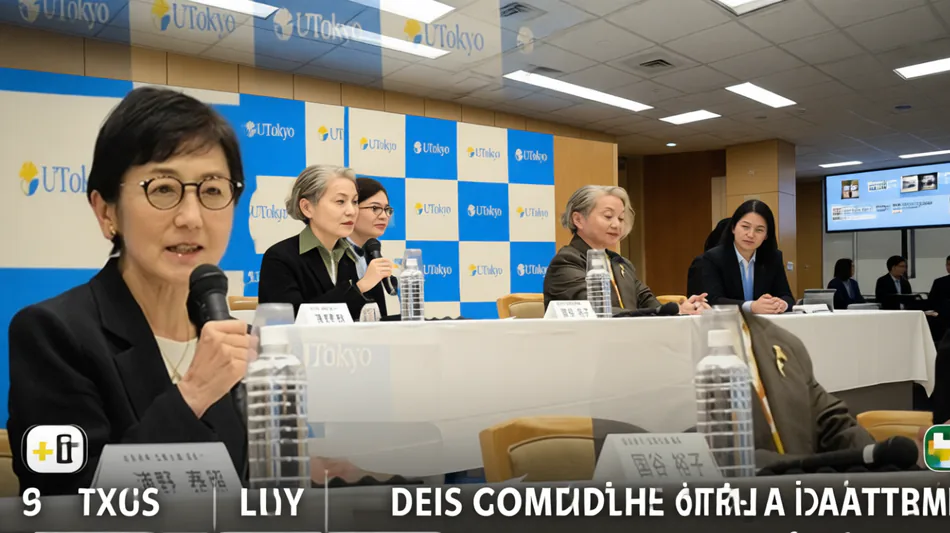
Yuko Fujigaki was selected on September 28 as the next president of the University of Tokyo, becoming the first woman to lead the prestigious institution in its 150-year history. The choice appears to have been driven by a combination of the university’s desire for scandal-free leadership and the strategic necessity of securing entry into a national research excellence fund.
The selection process concluded after a closed-door session that lasted more than eight hours, an unusually long duration for such meetings according to sources involved in the proceedings. The primary focus of the discussions was the university’s standing in the government’s Universities for International Research Excellence project. Institutions selected for this program receive tens of billions of yen annually over several years to support their development as world-class research centers.
Since 2024, Tohoku University, the Institute of Science Tokyo, and Kyoto University have been chosen for the program. The University of Tokyo, commonly known as Todai, has remained under "continued evaluation" by the expert panel responsible for selecting participants. The panel had warned that it would abruptly terminate the evaluation process if another governance-related scandal emerged while the university was in this interim status.
A significant factor influencing the selection was a corruption scandal involving a professor at the university hospital, which came to light in 2025. The manner in which Todai officials handled the incident raised concerns about the adequacy of its governance structures. With the deadline for the evaluation process approaching in December, those involved in selecting a new president sought a candidate who could effectively guide the university toward inclusion in the research program.
By the time of the September 28 meeting, the field of candidates had been narrowed to five. Faculty members cast their initial votes among these candidates, with the top three advancing to a second round of voting. In this subsequent round, Takao Someya, a professor in the Graduate School of Engineering, received 1,107 votes, while Fujigaki, a professor in the Graduate School of Arts and Sciences, placed second with 553 votes.
Following the faculty vote, the selection committee evaluated whether Someya could successfully lead Todai into the research excellence program. A major obstacle was a scandal revealed in July at an affiliated corporation, the Foundation for the Promotion of Engineering Research, which is scheduled to be disbanded in March 2027. Someya served as a representative director of the foundation during the period when the misconduct occurred.
The former secretariat-general of the foundation, who has since been dismissed, embezzled approximately 90 million yen ($564,000) over a ten-year period starting from fiscal 2016. Executives of the Graduate School of Engineering typically serve as directors of the foundation, and Someya held the position of representative director at the time of the scandal. Sources indicated that a significant portion of the selection meeting was dedicated to discussing whether Someya had failed to prevent the embezzlement.
Concerns that the scandal might jeopardize Todai’s chances in the research program likely contributed to the committee’s decision to pivot toward Fujigaki. On October 13, numerous Todai faculty members submitted a request to the selection committee for answers regarding how the new president was chosen. Among the inquiries were questions from education ministry officials who felt that Todai’s explanation of the selection process was insufficient.
The selection committee did not provide a detailed account of the meeting, citing confidentiality concerns. In response, the education ministry sent a written document to Todai on October 20, requesting an assessment of the selection process. This marked the first time the ministry had ever asked any national university to explain its presidential selection procedure.
On October 30, the selection committee submitted a document to the education ministry explaining that Fujigaki received the most votes among committee members in their final deliberation.
F.Carpenteri--NZN