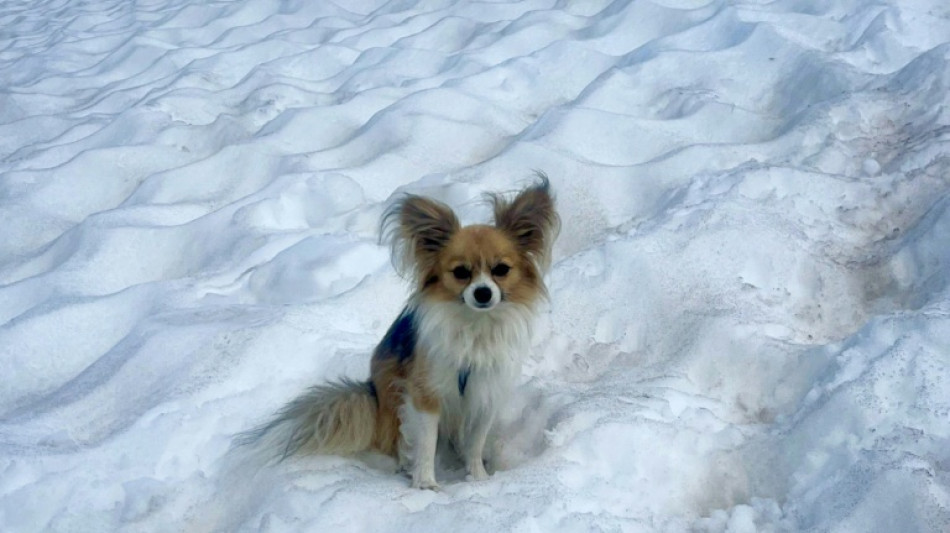
Scientists say most dogs have some wolf DNA - even chihuahuas / Photo: HANDOUT - Air Zermatt/AFP/File
Those tiny, fluffy dogs walking down the street may look cute but beware -- they probably have some wolf in them.
That is the discovery announced on Monday by US scientists, who were surprised to find that nearly two thirds of all dog breeds have a detectable amount of wolf DNA.
And it is not genetic leftovers from when dogs originally evolved from wolves around 20,000 years ago, but instead suggests that domesticated dogs and wild wolves have interbred within the last few thousand years.
This does not mean that "wolves are coming into your house and mixing it up with your pet dog," Logan Kistler, a curator at the Smithsonian Museum of Natural History and co-author of a new study, told AFP.
It also seems to have influenced the size, smelling power and even personality of modern dog breeds, the scientists said.
Dogs and wolves can produce offspring together, but interbreeding is thought to be rare.
"Prior to this study, the leading science seemed to suggest that in order for a dog to be a dog, there can't be very much wolf DNA present, if any," lead study author Audrey Lin of the American Museum of Natural History said in a statement.
To find out more, the team analysed thousands of dog and wolf genomes in publicly available databases.
They found that over 64 percent of modern breeds have wolf ancestry, with even tiny chihuahuas carrying around 0.2 percent.
"This completely makes sense to anyone who owns a chihuahua," Lin joked.
- Who is the most 'wolfy'? -
Czechoslovakian and Saarloos wolfdogs had the most wolf DNA, with up to 40 percent.
For breeds used as pets, the most "wolfy" was the Grand Anglo-Francais Tricolore hound, with around five percent of wolf DNA. Sight hounds such as Salukis and Afghans also ranked high.
While dogs with wolf DNA tended to be bigger, this was not always the case -- Saint Bernards did not have any.
The research also showed that 100 percent of village dogs -- which live on human settlements but are not anyone's pet -- have wolf ancestry.
Kistler speculated that village dogs, which have more opportunities to get intimate with wolves, could be how wolf DNA was getting into the dog gene pool.
Female wolves separated from their wolf pack by human activities such as habitat destruction could end up breeding with stray dogs, he suggested.
- Friendly or territorial? -
The researchers also compared their findings to the terms that kennel clubs use to describe the personalities of different breeds.
Breeds with little or no wolf in them were more likely to be described as friendly, easy to train and affectionate.
On the other hand, dogs with more wolf DNA were more often considered to be suspicious of strangers, independent, dignified or territorial.
Kistler emphasised that descriptions of breeds are imperfect and do not predict the behaviour of any individual dog.
"Wolves are evolved for specific habitats and specific conditions, and dogs have been carried to every corner of the inhabited world by people," he said.
Dogs have simply had to adapt to the places humans took them, and "wolf genes that gave them advantages in certain contexts," he explained.
For example, many Tibetan breeds, such as the fluffy little Lhasa Apso, have a gene called EPAS1 that came from adapting to higher altitudes. Tibetan wolves have the same gene.
The study was published in the Proceedings of the National Academy of Sciences.
F.E.Ackermann--NZN