Zürcher Nachrichten - Climate change intensified back-to-back Philippines storms: study

EUR -
AED 4.251055
AFN 74.082723
ALL 95.018841
AMD 426.494799
ANG 2.072456
AOA 1062.618368
ARS 1653.343639
AUD 1.642361
AWG 2.08533
AZN 1.972406
BAM 1.955776
BBD 2.331072
BDT 142.358264
BGN 1.957255
BHD 0.436195
BIF 3438.058076
BMD 1.157536
BND 1.485982
BOB 7.997902
BRL 5.858873
BSD 1.157386
BTN 110.026658
BWP 15.58081
BYN 3.202261
BYR 22687.703345
BZD 2.327772
CAD 1.619914
CDF 2656.545275
CHF 0.925474
CLF 0.026526
CLP 1047.457227
CNY 7.838259
CNH 7.828948
COP 4043.150698
CRC 526.49358
CUC 1.157536
CUP 30.674701
CVE 110.263655
CZK 24.163219
DJF 206.107487
DKK 7.47896
DOP 67.959171
DZD 154.092121
EGP 60.014268
ERN 17.363038
ETB 182.377176
FJD 2.564989
FKP 0.863389
GBP 0.866063
GEL 3.073304
GGP 0.863389
GHS 12.846843
GIP 0.863389
GMD 84.500531
GNF 10138.876366
GTQ 8.822892
GYD 242.147047
HKD 9.07051
HNL 30.948623
HRK 7.539962
HTG 151.328155
HUF 352.180742
IDR 20580.17776
ILS 3.380954
IMP 0.863389
INR 110.093821
IQD 1516.181512
IRR 1592627.583987
ISK 144.287295
JEP 0.863389
JMD 183.457763
JOD 0.820739
JPY 185.466233
KES 149.878172
KGS 101.226958
KHR 4649.943298
KMF 493.110692
KPW 1041.782702
KRW 1757.163068
KWD 0.357077
KYD 0.964588
KZT 565.963099
LAK 25485.689227
LBP 103649.83609
LKR 388.015269
LRD 210.647431
LSL 18.85217
LTL 3.417903
LVL 0.700182
LYD 7.37691
MAD 10.719669
MDL 20.213754
MGA 4829.941104
MKD 61.644248
MMK 2429.604626
MNT 4141.535985
MOP 9.341386
MRU 45.90344
MUR 54.694009
MVR 17.895943
MWK 2006.975527
MXN 19.936129
MYR 4.696822
MZN 73.97086
NAD 18.85217
NGN 1574.831883
NIO 42.589481
NOK 11.012222
NPR 176.042853
NZD 1.985312
OMR 0.444785
PAB 1.157386
PEN 3.936152
PGK 5.067938
PHP 70.344658
PKR 322.017173
PLN 4.248099
PYG 7086.913582
QAR 4.231048
RON 5.239128
RSD 117.358569
RUB 83.873777
RWF 1699.679274
SAR 4.345163
SBD 9.313039
SCR 16.281001
SDG 695.104554
SEK 10.971924
SGD 1.486859
SHP 0.864217
SLE 28.533689
SLL 24272.952982
SOS 661.491934
SRD 43.418597
STD 23958.655763
STN 24.499701
SVC 10.126877
SYP 127.94487
SZL 18.83677
THB 38.051721
TJS 10.786968
TMT 4.062951
TND 3.395559
TOP 2.787069
TRY 53.515782
TTD 7.861904
TWD 36.603025
TZS 3038.162953
UAH 51.861668
UGX 4339.947079
USD 1.157536
UYU 46.74943
UZS 13861.830968
VES 673.637084
VND 30454.769133
VUV 136.790409
WST 3.175689
XAF 655.949001
XAG 0.017014
XAU 0.000275
XCD 3.128299
XCG 2.085875
XDR 0.81579
XOF 655.949001
XPF 119.331742
YER 276.192216
ZAR 18.880892
ZMK 10419.216157
ZMW 20.219753
ZWL 372.726083
  • CMSD

    -0.0400

    22.26

    -0.18%

  • JRI

    -0.0300

    12.8

    -0.23%

  • NGG

    0.3200

    81.84

    +0.39%

  • RBGPF

    0.0000

    60.72

    0%

  • BCC

    0.4800

    71.14

    +0.67%

  • RELX

    0.6300

    33.74

    +1.87%

  • BCE

    0.0200

    24.59

    +0.08%

  • RYCEF

    0.4600

    17.5

    +2.63%

  • CMSC

    -0.0200

    22.33

    -0.09%

  • RIO

    1.7100

    105.35

    +1.62%

  • GSK

    0.1800

    53.04

    +0.34%

  • VOD

    0.2700

    15.53

    +1.74%

  • BTI

    0.9300

    62.32

    +1.49%

  • BP

    0.1000

    42.78

    +0.23%

  • AZN

    -3.5300

    178.75

    -1.97%

Climate change intensified back-to-back Philippines storms: study
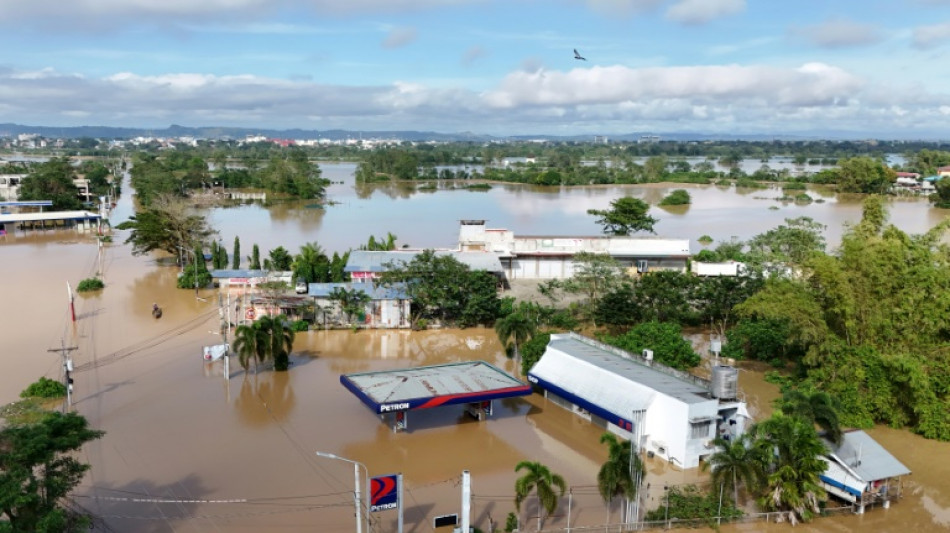
Climate change intensified back-to-back Philippines storms: study / Photo: John Dimain - AFP

Climate change intensified back-to-back Philippines storms: study

Human-induced climate change fuelled a rare string of back-to-back typhoons that battered the Philippines this year and boosted the chances of powerful storms making landfall, a new study said on Thursday.

Text size:

Five typhoons and a tropical storm hit the Philippines in a 23-day period across October and November, killing more than 170 people and causing at least $235 million in damage, according to local authorities.

About 20 big storms and typhoons hit the Southeast Asian nation or its surrounding waters each year, killing scores of people.

However, it is rare for multiple major weather events to hit over such a short period.

To assess the role of climate change in the string of storms, scientists from the World Weather Attribution (WWA) network used modelling to compare weather patterns in today's world against a hypothetical world without human-induced warming.

"Our results show that conditions conducive to the development of consecutive typhoons in this region have been enhanced by global warming," they said in a study published late Thursday.

"The chance of multiple major typhoons making landfall will continue to increase as long as we continue to burn fossil fuels."

The research, which uses a peer-reviewed methodology, found climate change made the conditions that formed and fuelled the typhoons twice as likely.

Globally, the number of tropical cyclones is not increasing significantly.

However, warmer seas are helping fuel an increasing number of strong storms and a warmer atmosphere holds more moisture, which results in storms that drop more rain.

- 'Difficult to recover' -

The study found that the warmer climate makes it 25 percent more likely that at least three Category 3-5 typhoons will make landfall in the Philippines in a year.

"Such consecutive extreme events make it difficult for populations to recover," the scientists warned.

And the world's current warming trajectory puts the Philippines on course for even worse effects, the study said.

Tropical storm Trami, considered by Philippines civil defence officials as the deadliest storm to hit the country this year, submerged hundreds of villages in the northern Philippines and displaced more than half a million residents.

Super Typhoon Man-yi, which brought havoc to Catanduanes province last month, also caused a province-wide power outage that authorities are still struggling to rectify.

"While it is unusual to see so many typhoons hit the Philippines in less than a month, the conditions that gave rise to these storms are increasing as the climate warms," said Ben Clarke, a researcher at Imperial College London's Centre for Environmental Policy.

The study warned that the repeated storms created a "perpetual state of insecurity", with about 13 million people affected by at least three of the extreme weather systems.

The Philippines needs major investment to tackle the challenges it faces from climate change, the scientists said.

"But of course funding adaptation isn't enough to protect the Philippines from climate change," said Friederike Otto, the scientist who leads WWA.

"Unless the world stops burning fossil fuels, typhoons will continue to intensify."

M.Hug--NZN