Zürcher Nachrichten - First major chunk breaks off world's biggest iceberg

EUR -
AED 4.24074
AFN 72.747691
ALL 95.895133
AMD 436.035414
ANG 2.067062
AOA 1058.887004
ARS 1597.14826
AUD 1.653535
AWG 2.0814
AZN 1.966277
BAM 1.954614
BBD 2.329187
BDT 141.903893
BGN 1.973789
BHD 0.433337
BIF 3423.122848
BMD 1.154729
BND 1.479003
BOB 7.991047
BRL 6.142352
BSD 1.156498
BTN 108.115396
BWP 15.769909
BYN 3.508595
BYR 22632.694475
BZD 2.325889
CAD 1.58378
CDF 2627.009167
CHF 0.911347
CLF 0.026718
CLP 1054.995133
CNY 7.95193
CNH 7.985934
COP 4268.503083
CRC 540.172223
CUC 1.154729
CUP 30.600327
CVE 110.198132
CZK 24.510626
DJF 205.935039
DKK 7.472149
DOP 68.648344
DZD 151.793891
EGP 60.003318
ERN 17.32094
ETB 182.257927
FJD 2.55709
FKP 0.865494
GBP 0.866919
GEL 3.135129
GGP 0.865494
GHS 12.60635
GIP 0.865494
GMD 84.876085
GNF 10136.848958
GTQ 8.858625
GYD 241.950042
HKD 9.043552
HNL 30.610955
HRK 7.53426
HTG 151.717938
HUF 393.547918
IDR 19621.160435
ILS 3.590198
IMP 0.865494
INR 108.324752
IQD 1514.980709
IRR 1519190.748592
ISK 143.82149
JEP 0.865494
JMD 181.692896
JOD 0.818703
JPY 184.287291
KES 149.814345
KGS 100.978653
KHR 4621.195857
KMF 493.069599
KPW 1039.260968
KRW 1742.561599
KWD 0.354005
KYD 0.963715
KZT 555.992624
LAK 24833.715834
LBP 103570.056743
LKR 360.757968
LRD 211.631582
LSL 19.508693
LTL 3.409615
LVL 0.698484
LYD 7.403508
MAD 10.806402
MDL 20.139605
MGA 4822.220038
MKD 61.60262
MMK 2424.299257
MNT 4118.861959
MOP 9.334836
MRU 46.292909
MUR 53.706697
MVR 17.85242
MWK 2005.443881
MXN 20.75095
MYR 4.549061
MZN 73.808037
NAD 19.508862
NGN 1566.089785
NIO 42.554178
NOK 11.072601
NPR 172.983536
NZD 1.986219
OMR 0.441332
PAB 1.156483
PEN 3.998274
PGK 4.991971
PHP 69.571301
PKR 322.895052
PLN 4.278215
PYG 7553.416585
QAR 4.228934
RON 5.088547
RSD 117.378775
RUB 97.510497
RWF 1682.708077
SAR 4.335894
SBD 9.297488
SCR 15.868071
SDG 693.992302
SEK 10.819427
SGD 1.481801
SHP 0.866346
SLE 28.377449
SLL 24214.108766
SOS 660.910406
SRD 43.287914
STD 23900.565327
STN 24.485142
SVC 10.11886
SYP 127.671546
SZL 19.515834
THB 38.137236
TJS 11.10776
TMT 4.0531
TND 3.415527
TOP 2.78031
TRY 51.181643
TTD 7.846171
TWD 37.086405
TZS 2997.126504
UAH 50.663993
UGX 4371.347465
USD 1.154729
UYU 46.600714
UZS 14099.444454
VES 525.044597
VND 30394.784897
VUV 137.673867
WST 3.149861
XAF 655.570554
XAG 0.017624
XAU 0.000264
XCD 3.120714
XCG 2.084217
XDR 0.81533
XOF 655.559207
XPF 119.331742
YER 275.517486
ZAR 19.768269
ZMK 10393.950388
ZMW 22.580298
ZWL 371.822367
  • RBGPF

    -13.5000

    69

    -19.57%

  • VOD

    -0.0900

    14.33

    -0.63%

  • BTI

    -1.3500

    57.37

    -2.35%

  • BCE

    0.0600

    25.79

    +0.23%

  • GSK

    -0.5300

    51.84

    -1.02%

  • NGG

    -3.5400

    81.99

    -4.32%

  • RYCEF

    -1.2600

    15.34

    -8.21%

  • RIO

    -2.5000

    83.15

    -3.01%

  • CMSC

    -0.2000

    22.65

    -0.88%

  • RELX

    -0.4600

    33.36

    -1.38%

  • CMSD

    -0.2420

    22.658

    -1.07%

  • BP

    -1.0800

    44.78

    -2.41%

  • BCC

    -1.5600

    68.3

    -2.28%

  • AZN

    -5.3300

    183.6

    -2.9%

  • JRI

    -0.3900

    11.77

    -3.31%

First major chunk breaks off world's biggest iceberg
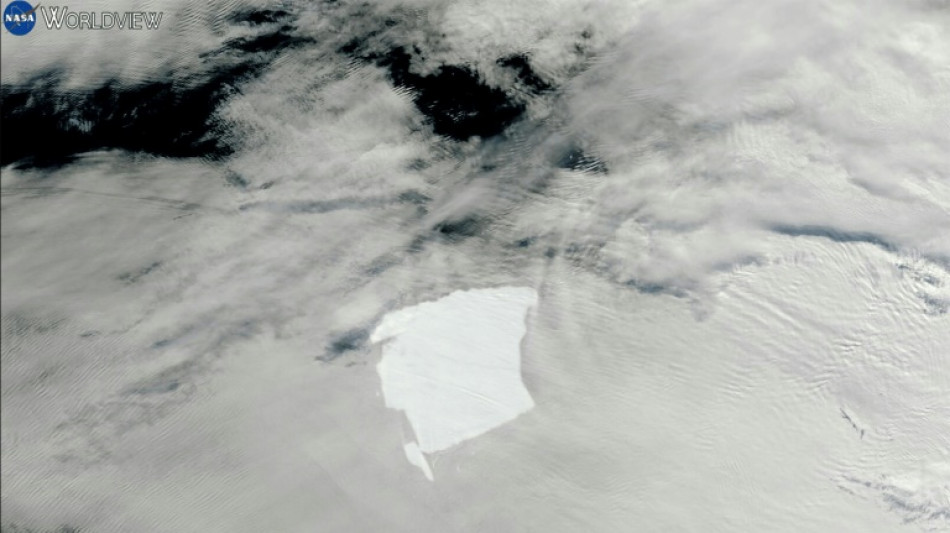
First major chunk breaks off world's biggest iceberg / Photo: Handout - NASA/AFP

First major chunk breaks off world's biggest iceberg

An enormous chunk has broken off the world's largest iceberg, in a possible first sign the behemoth from Antarctica could be crumbling, scientists told AFP on Friday.

Text size:

The colossal iceberg -- which is more than twice the size of Greater London and weighs nearly one trillion tonnes -- had largely stayed intact since it started slowly moving north in 2020.

It has been drifting toward the remote island of South Georgia in the South Atlantic, raising the prospect it could run aground in shallower water and disrupt feeding for baby penguins and seals.

But a chunk about 19 kilometres (12 miles) long has cleaved off, said Andrew Meijers from the British Antarctic Survey, who encountered the iceberg in late 2023 and has tracked its fate via satellite ever since.

"This is definitely the first significant clear slice of the iceberg that's appeared," the physical oceanographer told AFP.

Soledad Tiranti, a glaciologist currently on an Argentinian exploration voyage in the Antarctic, also told AFP that a section had "broken" away.

The jagged piece has an area of roughly 80 square kilometres (31 square miles) -- huge in its own right, but just a fraction of the approximately 3360 square kilometres that remained.

Meijers said icebergs were full of deep fractures, and although this monumental specimen had shrunk over time and lost a much smaller piece, it had "held together pretty nicely".

"This is a sign that those rifts in it are starting to break up," he said.

In the past, other mega-icebergs had fallen apart "relatively quickly over the course of several weeks" once they started losing big pieces, he said.

It was hard to say if this was "a loose tooth just waiting to come out" or evidence of a much bigger change underway.

"I'm sorry to say but it's not really an exact science how these things fall apart... it's really hard to say if this is going to blow apart now, or it's going to hang together for longer," Meijers said.

Known as A23a, the world's biggest and oldest iceberg calved from the Antarctic shelf in 1986.

It remained stuck for over 30 years before finally breaking free in 2020, its lumbering journey north sometimes delayed by ocean forces that kept it spinning in place.

This monster block of freshwater was being whisked along by the world's most powerful ocean "jet stream" -- the Antarctic Circumpolar Current.

Meijers said its trajectory toward South Georgia, a crucial feeding ground for seals and penguins, would unlikely change because it had lost this chunk.

But should it collapse further it would pose "much less of a threat for wildlife" because foraging animals could manoeuvre unimpeded between the smaller chunks to find food, he added.

Icebergs had grounded there in the past and caused significant mortality to penguin chicks and seal pups.

Tiranti said the iceberg was expected to keep plodding its way north but its exact course depended greatly on how local currents influenced its movements.

burs-np/yad

L.Muratori--NZN