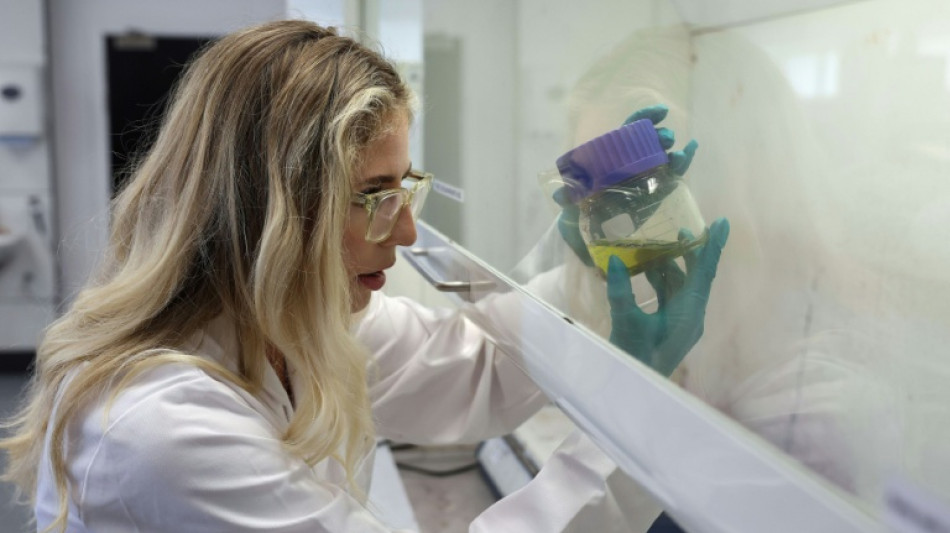
Britain's Royal Mint strikes gold in electronic waste / Photo: Darren Staples - AFP
At the heart of Britain's coin factory, old Bank of England telephones are stripped down and dipped into giant vats to recover a hidden treasure: the gold in their circuits.
Behind barbed wire and coded security gates at its site near Cardiff in Wales, the Royal Mint -- the state-owned maker of British coins as well as medals -- is turning electronic waste into luxury jewellery.
The initiative remains unusual in a sector where much electronic waste never reaches proper recycling facilities.
Opened two years ago, the plant can process around 4,000 tonnes of electronic waste a year, containing "about 400 kilos of gold", said the Mint's development director, Sean Millard.
Behind him, a largely automated line of chemical vats is off limits to cameras because the process is patented by a Canadian company, Excir.
- New process -
Each Bank of England office phone recycled here contains around 30 milligrammes of gold, worth around three pounds ($4.00) at current prices. A modern smartphone contains roughly four pounds' worth of the metal.
Gold is prized in electronic circuits because it conducts electricity well and does not corrode.
But its chemical stability also makes it difficult to recover from electronic waste.
Unlike many recyclers, which melt electronic waste in bulk, the Royal Mint dismantles devices first.
Copper, tantalum and even the plastic from circuit boards are sorted and sold to specialist recyclers.
Gold is traditionally recovered either by smelting at very high temperatures or by using corrosive acid mixtures that generate hazardous waste.
Instead, the Royal Mint uses a process that dissolves the gold at room temperature.
"There's no external energy input and it can be reused for batch after batch of feedstock," said Kate Griffiths, a chemical analyst at the Royal Mint.
She demonstrates the process by placing electronic components in a chemical bath and adding reagents one by one until a fine gold powder forms.
- 'Win-win' -
Once refined to improve its purity, the extracted gold is used to make jewellery for the Royal Mint's "886" brand, which refers to the date the institution was founded.
The mint also uses recycled silver, some of it extracted from old radios supplied by British hospitals.
In the jewellery workshop, quieter than the Royal Mint's coin-pressing halls where he used to work, 63-year-old John Powell carefully polishes a ring.
"I wouldn't be able to tell you whether I'm working with the recycled or the normal," he said.
Worldwide, only 22.3 percent of electronic waste was properly collected and recycled in 2022, according to a United Nations report.
Improper recycling can release lead, mercury or plastics into the environment and contribute to climate change, the report warned.
At the same time, soaring gold prices have made recovering increasingly attractive.
The metal climbed to a record high of nearly $5,600 an ounce at the end of January amid global economic uncertainty, though it has since fallen back to around $4,000.
"When the price of gold is really high, the cost of processing the waste to recover the gold is irrelevant," making alternative solutions commercially viable, said Jason Hallett, a professor of sustainable chemical technology at Imperial College London.
"It's a win-win," he said, as long as the extraction processes do not send energy consumption or emissions soaring.
O.Pereira--NZN