Major trade wars since the 19th century / Photo: Paul J. RICHARDS - AFP/File
As the world reels from US President Donald Trump's tariffs onslaught, here is a look back at some major trade wars since the 19th century:
- 19th century Opium Wars -
In the mid-19th century, two conflicts over the opium trade, which became known as the Opium Wars, pitted China against the British Empire.
The first began in 1839, when Britain launched a military expedition to force China to open its market to Indian opium sold by British merchants.
Britain won the clash in 1842, with success going beyond opium as China was forced to give up the region of Hong Kong, open five ports to world trade, and limit its customs tariffs to five percent.
In the second Opium War, from 1856-1860, Britain allied with France, and again the imperial power came out on top, forcing China to open up eleven additional ports to foreign trade and maintain diplomatic relations with the West.
- 1890: McKinley offensive -
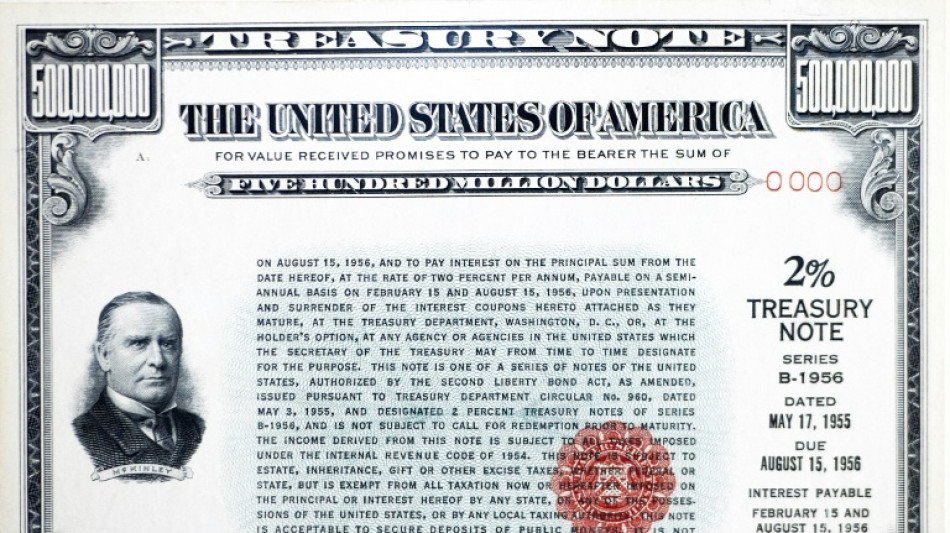
In 1890, William McKinley -- then a Republican lawmaker, later a US president -- saw through a new law that slapped an average tariff of nearly 50 percent on imports into America.
While the tax hike boosted the development of tinplate production in the US, for example, it also caused prices to soar.
In elections that same year for the US House of Representatives, Republicans suffered big losses, losing their majority to the Democrats. Two years later, the incumbent Republic president was dumped by voters in favour of a Democrat.
McKinley's unpopular law was repealed in 1894.
He nevertheless went on to become US president in 1897. He was assassinated in 1901, months after winning a second term.
Trump often mentions as McKinley as inspiration his protectionist policies.
- 1930: Smoot–Hawley Act -
The Smoot-Hawley Act, named after the two US politicians behind it, imposed tariffs of nearly 60 percent on over 20,000 imported agricultural and industrial products.
Trade partners, led by Canada, retaliated with taxes on US exports, which fell by more than 61 percent between 1929 and 1933.
- 1960s: Chicken war -
In the early 1960s, France and Germany jointly decided to tax the import of US chicken, produced at industrial scale.
The United States retaliated with taxes on a series of products, particularly on certain utility vehicles, which remain taxed to this day.
The so-called Chicken War ran from 1961 to 1964.
- 1985: Pasta war -
This dispute began in 1985 when president Ronald Reagan, in a bid to protect US industry, raised tariffs on pasta imports from Europe .
Europe responded with taxes on US imports of nuts and lemons.
The standoff lasted nine months before the United States and the European Economic Community (EEC) -- as the EU was then known -- reached an agreement.
- 1989-2009: Beef hormone dispute -
In 1989, the EEC banned imports of beef treated with growth hormones.
After challenging the measure at the World Trade Organization (WTO), which ruled in their favour, the United States and Canada, the countries most affected, imposed 100-percent tariffs in 1999 on a range of European goods, from French Roquefort cheese to Italian truffles.
In a compromise deal inked in 2009, these taxes were eventually suspended, and European import quotas for high-quality, hormone-free beef were gradually increased, leading to a final agreement in 2019.
- 1993–2012: Banana war -
In 1993, the EU granted preferential customs regimes to the former European colonies in Africa, the Caribbean and the Pacific, to the detriment of bananas produced by US multinationals in Latin American countries.
These countries filed a complaint with the WTO, which condemned the EU several times, and Latin American countries were authorised to apply retaliatory measures.
An agreement was signed in 2012, allowing for a reduction in import tariffs on bananas from 11 Latin American countries and the end of actions taken by these countries against the EU.
- 2002: Bush vs. EU -
In 2002, US President George W. Bush imposed three-year surcharges of up to 30 percent on 10 categories of products including flat-rolled steel, machine wires and welded tubes.
These measures, intended to boost the US steel industry, affected nearly 29 percent of imports.
The EU filed a complaint with the WTO and published a list of US products it threatened to tax by up to 100 percent.
At the end of 2003, Bush opted to lift the tariffs.
bur-paj-lc-eab/rmb
Ch.Siegenthaler--NZN