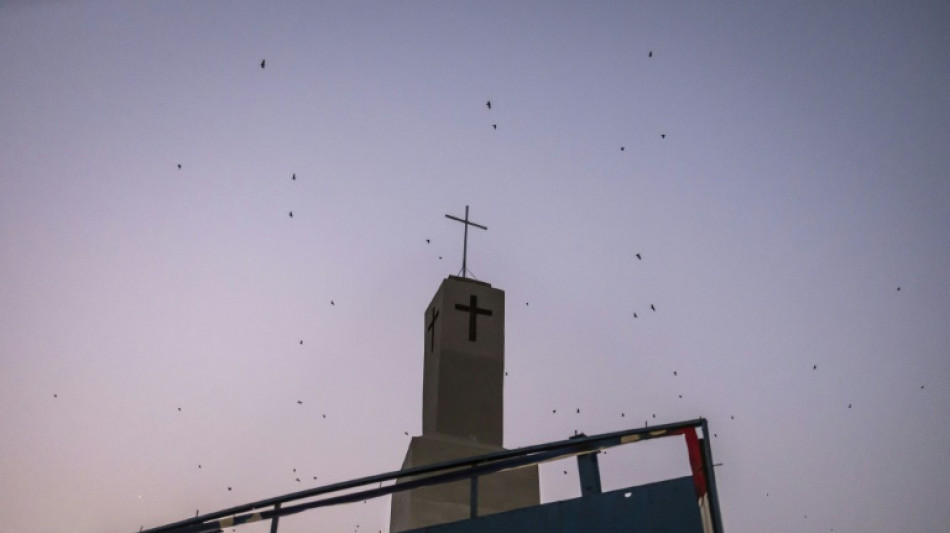
Nigerian mixed-faith families sense danger as violence flares / Photo: OLYMPIA DE MAISMONT - AFP
When the news came through of yet another massacre in the countryside in Nigeria's volatile Plateau state, local Christian Jamaima Haruna was terrified for her Muslim husband.
The slayings in the Bokkos district left 52 dead -- one of two major bouts of suspected intercommunal violence this month, in a state where Muslim herders and mostly Christian farmers regularly clash.
Haruna, 39, was selling potatoes in the market in Jos, the state capital. But her husband was travelling in the area where the killings were reported, in search of fresh produce for their business.
The fact that her husband was Muslim provided Haruna no comfort that he would be safe against killers on a rampage across the mostly Christian villages.
"I was terrified. The situation was tense, and I became so worried thinking about him. I instantly called his phone number about three times -- the calls did not go," Haruna told AFP.
Theirs is one of many mixed-faith marriages in Plateau, a grey area among the sometimes divisive rhetoric that often comes from Nigerian media and politicians whenever intercommunal violence flares.
Haruna's husband was fine, but what exactly happened in Bokkos earlier this month remains unclear.
Survivors told AFP that unidentified gunmen stormed the villages. A local official said the attackers spoke the "Fulani dialect".
A local pastoralist association representing Muslim Fulani herders slammed the remarks as irresponsible.
But amid the long-standing tensions in the area, things have sharply escalated: this week, another attack by unidentified gunmen left another 52 dead, this time in the villages of Zike and Kimakpa.
Politicians including Plateau state governor Caleb Manasseh Mutfwang said the massacres were part of a "genocide" that was "sponsored by terrorists".
Critics say that rhetoric masks the true causes of the conflict -- disputes over land and a failure by authorities and police to govern the countryside.
"It all boils down to the failure of governance at the lower level of Nigeria," said Isa Sanusi, Nigeria country director at Amnesty International. "The space has been taken over by impunity."
Rhetoric about a "genocide", he said, meanwhile "creates a situation where the fact that people accept to live together is now put to the test".
- History of religious mixing -
Mixed-faith families have long existed in Plateau, which lies midway between the country's mainly Christian south and mostly Muslim north.
The state's complicated history includes both communities living side by side, as well as explosions of violence.
The capital Jos saw deadly sectarian riots in 2001 and 2008 that together killed more than a thousand people, according to rights groups. Peace efforts in the city since then have brought calm, though the countryside remains restive.
Land grabbing, political and economic tensions between local "indigenes" and those considered outsiders, as well as an influx of hardline Muslim and Christian preachers, have heightened divisions in recent decades.
Land used by farmers and herders, meanwhile, is coming under stress from climate change and human expansion, sparking deadly competition for increasingly limited space.
When violence flares, weak policing all but guarantees indiscriminate reprisal attacks.
Growing up, Solomon Dalung, a 60-year-old Christian, would go to the mosque when he was staying with his cousins, who lived in a town that did not have a church.
"Each time there is any crisis, religion and ethnicity is used as a fuel" to escalate it, said the former state sports minister.
At the same time, like other politicians, he insisted in an interview with AFP that the killings were "genocidal", accusing the attackers of "extermination of another group".
- 'In the spotlight' -
Tensions in Plateau can be especially dangerous for mixed families, as it "puts them in the spotlight", said Sanusi.
Usman Ahmad, a 71-year-old Muslim who has been married to a Christian for four decades, was also in the Jos market when he heard news of the Bokkos killings.
While he felt a sense of relief that his immediate community "is more enlightened" about mixed families, he also felt the need "to rush home and see what we can do in terms of appealing for calm", he said.
"Many times we sit to think (about) why this crisis refused to end. Is it because of religion, is it about tribalism or is it about wealth?" Jamaima Haruna told AFP from her market stand.
"Can't we think of other ways to respect our differences?"
S.Scheidegger--NZN