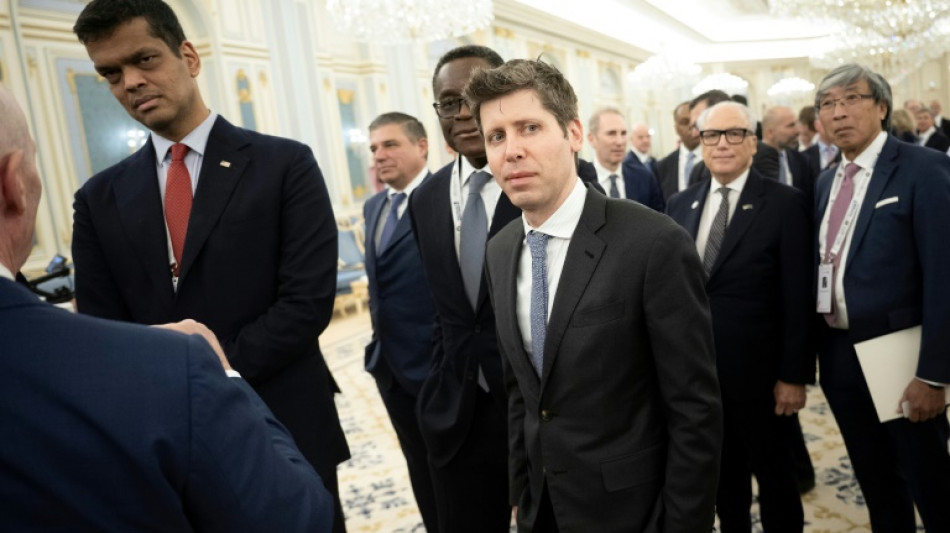
With Trump's second term, Big Tech embraces US exceptionalism / Photo: Brendan Smialowski - AFP
Big tech companies are increasingly waving the US flag in Washington where President Donald Trump is back in charge, pushing his America First agenda.
Leading this performance of nationalism are Meta, OpenAI and, more predictably, Palantir, the AI defense company founded by Peter Thiel, the conservative tech billionaire who has played a major role in Silicon Valley's rightward shift.
But the full-throated call to defend the nation -- often paired with warnings about communist China or Europe's regulation -- raises concerns about alienating international partners who represent a significant portion of big tech's business.
In the defense industry, US companies have historically balanced pro-American positioning with patriotic discretion to attract international business.
But Trump and Vice President JD Vance routinely denigrate close allies, all while promoting a nationalist agenda that many US companies feel little choice but to endorse.
While Saudi Arabia and other oil-rich Arab states largely escape Trump's ire, they are investing billions in US AI projects and building their own ventures with White House backing.
Perhaps most surprising is ChatGPT maker OpenAI's embrace of American exceptionalism.
The company now actively lobbies for US tech to become the global platform for generative AI, has adjusted policies to allow defense contracts, and is helping build AI for the Pentagon in partnership with drone maker Anduril, another Thiel-connected company.
"I don't want to live in Europe either," OpenAI CEO Sam Altman told a Senate panel on US AI dominance last week.
"I think America is just an incredible and special thing, and it will not only be the place where the AI revolution happens, but all the revolutions after."
Meta has similarly swung to the right since Trump's return.
CEO Mark Zuckerberg appointed a prominent Republican lobbyist to lead public policy, who regularly criticizes European regulations and aligns Meta's positions with conservative viewpoints.
The company has also touted AI models like its own as "essential for the US to win the AI race against China and ensure American AI dominance."
The most vocal proponent is likely Palantir, whose market valuation has soared based on expectations that its technology will transform security, surveillance and defense.
Tech "is more of a metier or an art form than a science. And all the artists are in America," said Palantir CEO Alex Karp at Washington's Hill and Valley tech conference earlier this month.
Palantir executives largely believe this can only be achieved through overwhelming American military and technological dominance, ensuring global peace through a Pax Americana.
"AI is scary (and) can be abused" by great powers, "which is why we have to win this in America," Karp stated.
- 'Tightrope' -
Professor Sarah Kreps, director of Cornell University's Tech Policy Institute, notes that defense technology companies like Palantir must balance US allegiance with respect for national sovereignty abroad.
"It's a diplomatic tightrope. When the political rhetoric becomes too parochial or polarizing—especially tied to specific administrations—it risks undermining" US companies' appeal overseas, she explained.
Trump's nationalism is pressuring companies to adopt patriotic positions that Silicon Valley traditionally avoided, but this "can create friction abroad, especially in Europe, where concerns about sovereignty, data localization, and technological dependence are growing," Kreps added.
Taking a more measured approach is Microsoft, the 50-year-old tech giant that—like rivals Google and Amazon Web Services—serves both the US government and foreign markets where American nationalism might deter potential customers.
For decades, co-chairman and president Brad Smith has navigated this complex terrain, aligning with Washington's political climate while reassuring global customers of Microsoft's trustworthiness. While co-founder Bill Gates, who now serves as an advisor to Microsoft, spoke out against Trump's tariffs this week, Smith walks the line more carefully.
"We need to remember that as a country, only four and a half percent of the world's people live in the United States," Smith told the same Senate panel where OpenAI's Altman advocated for US leadership in AI.
The risks extend beyond lost sales opportunities.
Microsoft's business, like all US tech giants, depends on agreements allowing transatlantic data flows—arrangements repeatedly challenged in EU courts.
Professor Susan Ariel Aaronson of George Washington University warns these arrangements are precarious.
"American AI will not be successful if it is not trusted. And how do you build trust? You don't become the world's disrupter," she told AFP.
X.Blaser--NZN