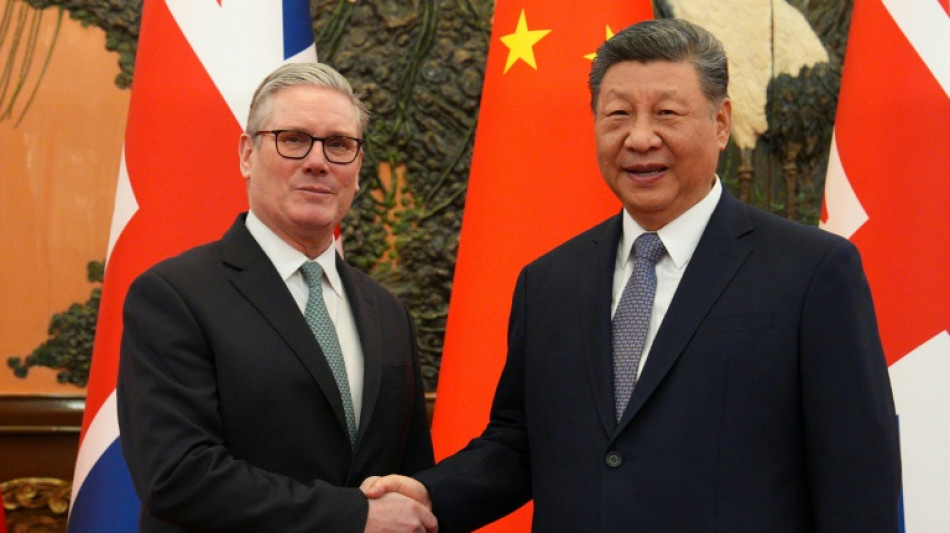
Trump-era trade stress leads Western powers to China / Photo: Carl Court - POOL/AFP
Britain's Keir Starmer is the latest Western leader to thaw trade ties with China in a shift analysts say is driven by US tariff pressure and unease over Donald Trump's volatile policy playbook.
The prime minister's Beijing visit this week to promote "pragmatic" co-operation comes on the heels of advances from the leaders of Canada, Ireland, France and Finland.
Most were making the trip for the first time in years to refresh their partnership with the world's second-largest economy.
"There is a veritable race among European heads of government to meet with (Chinese President) Xi Jinping," Hosuk Lee-Makiyama, director of the European Centre for International Political Economy, told AFP.
This is "driven by internal rivalry to secure investments and market access before the China-US summits in February and April", he said.
It's not just China looking more appealing these days: on Tuesday, India and the European Union announced a huge trade pact two decades in the making, a move to open new markets in the face of a strained status quo.
Vietnam and the European Union also on Thursday committed to deeper cooperation on trade, technology and security.
India and other emerging markets such as South America "are too small to sustain the world's most export-dependent economies, which are in Europe", Lee-Makiyama said.
So they have no choice but to turn to Beijing -- despite concern over its human rights record, and accusations of economic coercion.
"Half of economic growth is generated by either the United States or China," Lee-Makiyama said, adding that "the United States is hardly opening up".
- 'No longer reliable' -
Trump's unpredictable tariff onslaught signals that "the United States is no longer a reliable trading partner", said William Alan Reinsch at the Washington-based Center for Strategic and International Studies.
For the new EU-India Free Trade Agreement, "you can argue that, ironically, Trump's policies have pushed it across the finish line" 20 years since negotiations began, Reinsch told AFP.
Starmer told Xi on Thursday it was "vital" to develop the two countries' relationship, with the Chinese leader also stressing the need for stronger ties in the face of geopolitical headwinds.
London and Beijing enjoyed what they described as a "Golden Era" a decade ago but relations deteriorated from 2020 when Beijing imposed a national security law on Hong Kong.
Nonetheless, China remains Britain's third-largest trading partner, and Starmer's centre-left government is keen to boost UK economic growth.
While the European Union also wants stronger ties with China, it is alarmed by the current trade imbalance, with a gaping deficit of more than $350 billion to Brussels's disadvantage.
Irish Prime Minister Micheal Martin urged "open trade" in his talks with Xi in early January, while France's Emmanuel Macron denounced the trade imbalance on a visit to Beijing in December.
- More Trump threats -
China and India are also seeking ways to cope with Trump's tariffs designed to boost US manufacturing and "make America great again".
"A select few countries should not have privileges based on self-interest, and the world cannot revert to the law of the jungle where the strong prey on the weak," Chinese Vice Premier He Lifeng said at the World Economic Forum this month.
In some cases, Trump has retaliated with more tariff threats, including a new 100 percent levy on all Canadian goods if the US neighbour makes a trade deal with China.
Canadian Prime Minister Mark Carney hailed a "new strategic partnership" with China in Beijing this month, touting a "preliminary but landmark trade agreement" to reduce tariffs.
Under the deal, China, which used to be Canada's largest market for canola seed, is expected to reduce tariffs on the products to around 15 percent, down from the current 84 percent.
In return, Canada will import 49,000 Chinese electric vehicles under a preferential tariff rate.
Carney's visit "signalled a fundamentally new approach to how Ottawa intends to navigate a more fragmented, contested and uncertain world", wrote Vina Nadjibulla, vice-president of research and strategy at APF Canada.
But she warned it could risk being misinterpreted as "a softening of Canada's assessment of the national and economic security challenges China poses".
Reinsch at the CSIS predicted that the latest agreements would leave the United States at a disadvantage in the long run, while noting they were "surprisingly traditional".
Negotiations on lower tariffs and reducing non-tariff barriers are "exactly what the world has been doing for the past 75 years", he said.
"The outlier is the United States."
H.Roth--NZN