Syria UXO causing death, injury every six hours: charity / Photo: Bakr ALkasem - AFP
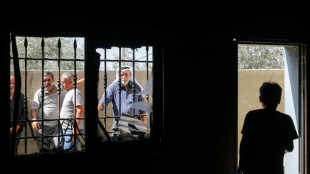
Malakeh Barbour caresses her son Haidar, his face scarred from a blast that killed his brother in their home in Syria, where a mine-clearance charity says unexploded ordnance claims a casualty every six hours.
Last winter, Barbour's children went out to collect plastic and other makeshift material to burn for heating.
"Without realising, they picked up an object left over from the war," Barbour, 40, told AFP from their home in the Damascus countryside.
When they returned, "it exploded after they put it into the heater," she told AFP, with the blast killing her son Ahmed, 17, and injuring her other sons, Haidar, 10, and Ghaith, seven.
"His death crushed us," Barbour said, weeping as she held a picture of Ahmed.
Since the December 2024 overthrow of longtime Syrian ruler Bashar al-Assad, international organisations and NGOs led by the United Nations Mine Action Service (UNMAS) say incidents involving unexploded ordnance have killed or injured at least 2,375 people, including more than 850 children.
The real toll is thought to be much higher.
During more than 13 years of war, different sides planted mines and explosive devices in various parts of the country, presenting a dangerous challenge as Syria seeks to recover and rebuild.
"Life has lost its meaning since we lost" Ahmed, said Barbour, who works in agriculture alongside her children.
Now "I'm afraid whenever one of the children leaves the house... it's as if my heart is aching."
- Years of work ahead -
In a preliminary report released in June, the Landmine and Cluster Munition Monitor said Syria had the highest number of casualties worldwide last year due to landmines and explosive war remnants, with some 1,600 victims.
Simon Jackson, Syria programme manager for mine-clearance charity the HALO Trust, told AFP "the average rate of accident is one person becoming a casualty every six hours" in Syria.
This year has seen almost 700 casualties from explosive accidents in the country, one-third of them deadly, he said, with one-third of all casualties being children.
More than 60 percent of incidents have taken place in agricultural land or grazing areas, he said, adding that early 2025 saw "a large spike in accidents as people rushed back to their communities" after Assad fell.
Specialised teams from organisations including the HALO Trust, in coordination with the new authorities, have been working on clearing mines across the country.
Unexploded ordnance prevents people "from rebuilding their homes, rebuilding their businesses. It prevents farmers from re-sowing crops", Jackson said, calling it an obstacle to "the recovery of the communities and the recovery of Syria".
He warned that "if we doubled the rate at which we are working as a sector, it would still take at least 10 years. We're really looking at sort of 20 to 30 years in total to solve this problem."
- Vast contamination -
On the outskirts of Damascus in the Jobar area, which saw fierce battles during the war, HALO Trust teams have been working for months between destroyed buildings and piles of debris.
Hussein Kazhali, HALO's head of operations in southern Syria, said that in around eight months of work in the neighbourhood, teams had only managed to clear around 200,000 square metres of roads.
He said large quantities of rubble, scrap metal and shrapnel complicated mine detection, along with shortages of resources, trained personnel and advanced equipment.
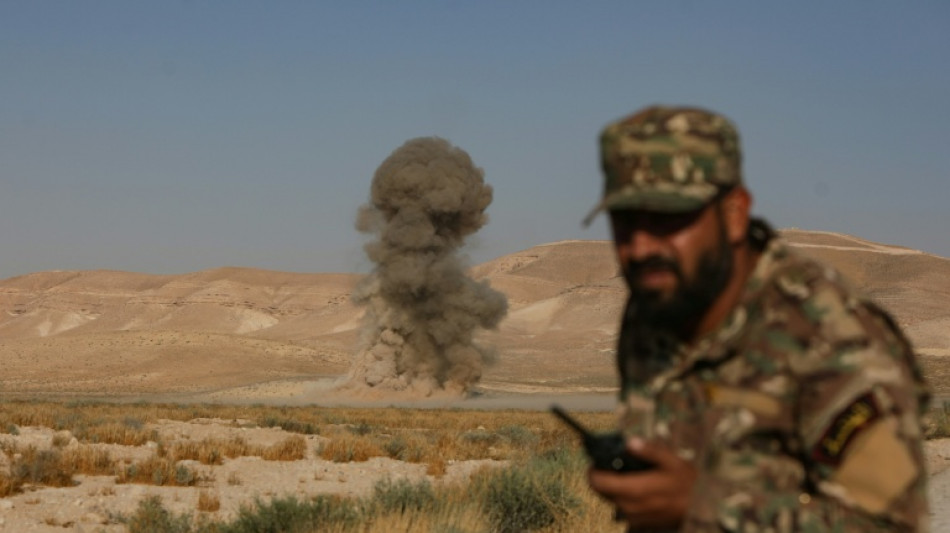
In the town of Qara in the Damascus countryside, a Syrian army minesweeping vehicle cut a path through arid land as exploding ordnance sent dust and smoke rising.
Nearby, personnel wearing protective gear inspected mines and munitions ahead of their destruction.
A source in the defence ministry's engineering units told AFP the ministry was gradually clearing land under a plan prioritising populated areas, roads and farmland.
Anti-personnel mines and anti-vehicle mines are the most common ordnance encountered, they said.
Key challenges include "the lack of maps of some minefields, and vast expanse of contaminated areas", with operations heavily dependent on available maps, reports from residents and field surveys, they added.
Since the new authorities took power, 47 soldiers have been killed and more than 90 others injured by mines and other unexploded ordnance, the source said on condition of anonymity.
The ministry lacks an accurate estimate of Syria's overall contaminated area, with new sites discovered daily.
"We can't specify a precise timeframe" for fully clearing mines and other ordnance, the source added.
J.Hasler--NZN