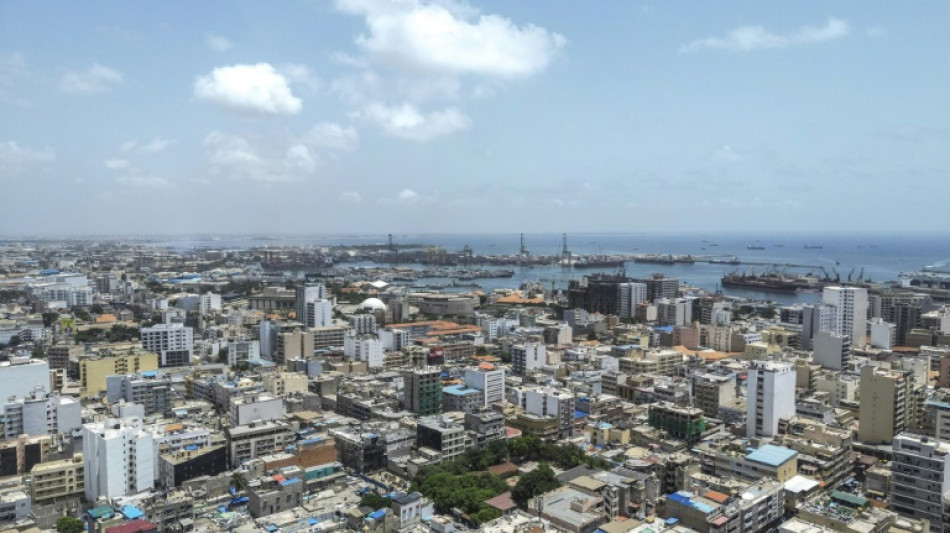
Senegal has an IMF loan, now what? / Photo: PATRICK MEINHARDT - AFP/File
Heavily indebted Senegal received a $2.2 billion lifeline from the IMF earlier this week. What does the three-year loan mean for the west African nation?
The agreement came after a prior 2023 IMF deal for $1.8 billion was suspended following the discovery of unreported debt under the previous administration.
With a total public-sector debt estimated at 132 percent of GDP at the end of 2024, Senegal is one of the most heavily indebted countries in sub-Saharan Africa.
From restructuring to the loan's role in Senegal's ongoing political drama, here is what is likely on the horizon.
- Road to more financing -
The International Monetary Fund's loan provides substantially less money than Senegal needs, but serves as a solid foundation by which the country can secure more financing.
"The agreement's strategic value lies less in its monetary value than in the confidence and leverage it can generate among donors, creditors and investors", said Amath Ndiaye, economist and researcher at Cheikh Anta Diop University in Dakar.
Senegal has been able to continue financing itself largely through regional financial markets but this comes at higher costs than loans from international financial institutions, development banks or governments.
The IMF loan programme, economists say, provides a catalyst for financing from other institutions such as the World Bank, African Development Bank, private investors and others.
- Restructuring, a dirty word -
Neither Senegal's bondholders nor its powerful opposition Pastef party like to speak of debt "restructuring".
Pastef leader Ousmane Sonko, Senegal's former prime minister who was fired by President Bassirou Diomaye Faye in May, has previously called restructuring a "disgrace" that would compromise Senegal's sovereignty.
Senegal confirmed it will implement an "enhanced version" of what is known as the "G20 Common Framework".
The mechanism, introduced by the world's richest countries in 2020, is meant to help struggling nations cancel some of their debts under strict conditions.
"Common framework means restructuring," Robert Besseling, CEO of Pangea-Risk, told AFP, adding that the "enhanced" component likely refers to an accelerated pace.
Sonko has recently softened his tone.
"It's easy to call a debt restructuring a disgrace, but (Sonko) does not want to be the reason that Senegal falls into even more economic and financial chaos," Besseling said.
Sonko now leads the Pastef-dominated National Assembly -- a role that could complicate Faye's ability to usher in IMF reforms.
Instead of "restructuring", the IMF referred to "debt treatment". The government too spoke of a "Senegal Debt Treatment Plan (PTDS)".
- Waiting for sign-off -
The staff-level agreement still needs approval by the IMF's executive board, which will happen at or before IMF annual meetings in October. At that point, more programme details will emerge.
"Reforms are not clearly defined in the agreement document. Some ambiguity remains", Abdoulaye Ndiaye, a Senegalese economist at New York University, told AFP.
Senegal still needs to mobilise funding with partners and determine how the reform framework will be implemented, he said.
Finance Minister Cheikh Diba said the agreement creates a budgetary margin allowing for increased social support and paying off debts to private companies.
However, energy subsidies which keep electricity prices in check will now be restricted to families "in need".
"Difficult choices" will have to be made regarding "projects to safeguard", NYU's Ndiaye said, especially with people weighed down by high living costs.
The IMF has been criticised in the past for imposing drastic budget cuts and structural reforms on countries.
- Senegal's economic standing -
Senegal's public debt is alarming, although similar situations have played out elsewhere in Africa.
Zambia defaulted on its sovereign debt in 2020, with its debt-to-GDP ratio peaking at 124 percent in 2021, and later completed an IMF-supported programme.
Ghana turned to the IMF amid spiralling debt, soaring inflation and a plunging currency, and subsequently secured a $3 billion programme in 2023.
Despite high debt "the Senegalese economy has remained resilient", the IMF said Tuesday, citing 6.7 percent growth in 2025 "driven by the first full year of oil production, although non-hydrocarbon GDP growth slowed to 2.2 percent".
Senegal launched production at its first offshore oil field in 2024.
- Local debt -
The IMF deal pertains only to external debt and not Senegal's CFA-denominated debt, which has been growing exponentially.
"That means that the common framework is only part of the solution," Besseling said.
The choice to exclude CFA debt was "crucial to prevent a Senegalese sovereign debt crisis from escalating into a regional banking crisis", said Ndiaye, of Cheikh Anta Diop University.
X.Blaser--NZN