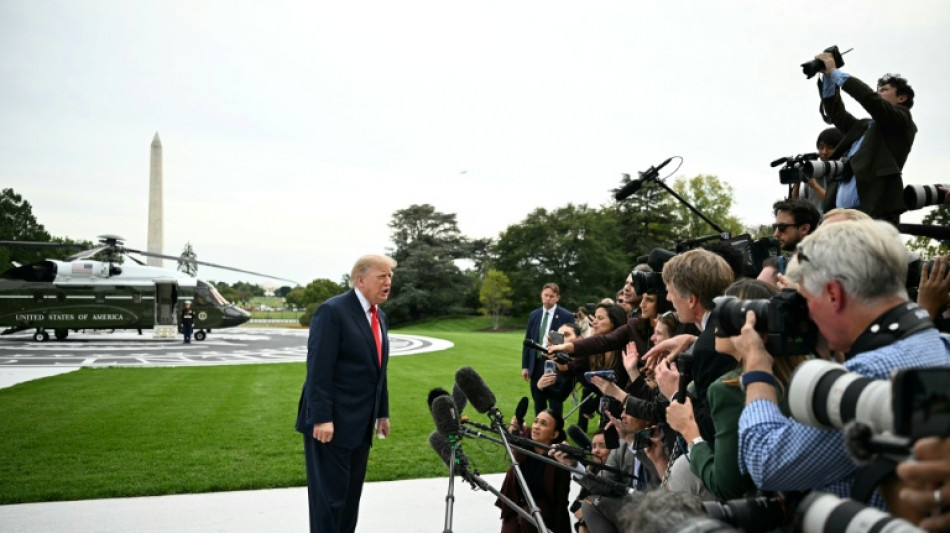
Trump hails Russia deal to release diesel as midterms loom / Photo: Alex WROBLEWSKI - AFP
US President Donald Trump said Friday that he had secured Russia's agreement for a major release of diesel, as he eased war sanctions on Moscow in a push to lower energy costs ahead of midterm elections.
Moscow has been hit with waves of sanctions by the United States and partners since its 2022 invasion of neighboring Ukraine, and President Volodymyr Zelensky criticized Trump for an "unworthy" and "weak" move.
The deal comes weeks before key US elections where Trump's Republican Party risks losing its grip on Congress as voters express frustration over the mounting cost of living.
Prices at US gasoline and diesel pumps have surged since late February, when US-Israel strikes targeting Iran triggered Tehran's blockage of the Strait of Hormuz, a critical waterway for energy transit.
"Russia will immediately supply over 300,000 Tons of Diesel Fuel to the American and Global Marketplace," Trump said on social media after talks with Russian leader Vladimir Putin.
The Kremin said Russia "reaffirmed its readiness to supply oil and oil products to the American and world markets."
Trump added Moscow would supply 500,000 tons in November, followed by one million tons, with further larger releases promised.
Zelensky told reporters: "It is certainly not honest, it is certainly unworthy of our partners, and it is, in my view, a weak decision."
The US Treasury issued a temporary license Friday to enable Russian diesel to flow to global markets through April 2027.
Angelo Kourkafas of Edward Jones noted that the deal with Russia is "alleviating some of the worst-case scenarios" on energy supplies and inflation.
- Conflict stalemate -
"Lower prices for Americans, especially our Great Farmers, Ranchers, and Truckers, is my Greatest Priority," Trump posted on social media.
The average cost of regular US gasoline has jumped more than 46 percent since late February to $4.37 per gallon, while that of diesel rocketed 67 percent over the same period to $6.28 per gallon.
News of the deal came as Ukrainian negotiators met US envoys on Friday in Miami in a fresh attempt to break the conflict's stalemate.
Trump has blamed Ukrainian strikes on Russian refineries for surging fuel prices, although the US-Israeli war with Iran has been the principal disruptor of global energy supplies.
The Miami meeting follows visits to Moscow and Kyiv last month by Steve Witkoff, a longtime Trump confidant, and Jared Kushner, the president's son-in-law, as Washington seeks to revive negotiations that have yielded little progress.
With winter approaching, the prospect of continued fighting and attacks on vital infrastructure has added urgency to the search for a settlement against a backdrop of deadly Russian attacks.
On Thursday a Russian strike on buses in the frontline Ukrainian city of Kramatorsk killed 30 people.
Trump's repeated attempts to broker an end to the war have foundered over Moscow's sweeping territorial demands, particularly its insistence on controlling all of Ukraine's eastern Donbas region, including areas still held by Kyiv.
Zelensky has rejected surrendering Ukrainian-held territory, warning that Russia could use it as a springboard for another attack.
Russia now occupies roughly one-fifth of Ukrainian territory.
The Miami discussions are also expected to cover security guarantees designed to protect Ukraine against future Russian aggression and plans for the country's post-war economic recovery, US officials said.
National security advisors from Britain, France and Germany were invited, along with representatives of NATO and the European Union.
G.Kuhn--NZN