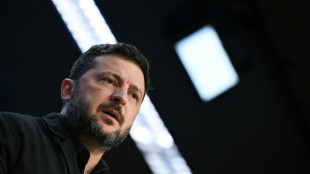
EU backs Ukraine on Starlink, but can't fill gap / Photo: YASUYOSHI CHIBA - AFP
The European Union has pledged to help Ukraine with its dependence on Starlink satellite communications to support battlefield operations, but the bloc is a long way from being able to match the US-owned system.
Ukraine reported restrictions this week on some Starlink internet terminals, which Kyiv says impeded its military ability to defend against Russian forces.
Disruption to the service operated by Elon Musk's SpaceX was flagged after a new souring of Kyiv's relations with President Donald Trump -- although a US official has denied any intervention by the president.
Speaking at a Brussels summit Friday, Ukrainian President Volodymyr Zelensky said Starlink services were still being restored, describing the disruption as "a very unpleasant and dangerous surprise".
EU leaders rallied around Zelensky, but admitted there were limits to how much Brussels can help with Kyiv's Starlink issues.
"We are working hard to help Ukraine strengthen its ability to defend itself through satellite imagery and early-warning systems, which are much needed," French President Emmanuel Macron told reporters after the Brussels talks.
But EU foreign policy chief Kaja Kallas warned earlier Friday Europe did not have a readily available alternative.
"Starlink is really necessary for Ukraine and unfortunately in (the) short term Europe can't replace this capability," Kallas said.
- EU satellite plans -
Currently, the European Union countries pool and share existing satellite communication capacities under GOVSATCOM operations, in which Europe wants to fully include Ukraine, EU spokesman Thomas Regnier said.
Then there is the Iris² project which envisages a network of communication satellites aiming to rival Starlink -- but that will only launch in 2029, aiming to be fully operational a year later.
Regnier said the EU wants to include commercial services within GOVSATCOM early next year to ramp up its ability to meet Europe's military needs until Iris² is operating.
Ukraine currently uses Elon Musk's Starshield, Starlink's military-grade satellite service, for its battlefield communications, mid-range strikes on Russian-occupied territory and interceptor drones.
It also uses SpaceX's parallel Starlink civilian satellite system, but not for offensive operations.
Musk has shifted stance on Ukraine many times since Russia's invasion in 2022.
But he said this week that any disruption was the responsibility of the US government, not his SpaceX firm.
- Urgent to build capacities -
Efforts to support Kyiv are not just limited to EU projects.
France-owned Eutelsat's OneWeb provides satellite communication services to Ukraine, although it remains tight-lipped on government and military uses.
But its 648 satellites are no match for Starlink which has over 10,000.
And according to specialist publication Via Satellite, Eutelsat's OneWeb constellation is unable to support drone and ground robot operations because of its limited capacity and lack of compact satellite terminals.
Despite member states' best efforts, collective projects have more chance of success, Brussels believes.
At the EU level, Kallas said the European Defence Agency had mapped all the "critical capabilities" that Europe was missing and that Europe needed to fill these gaps "as soon as possible".
European leaders echoed the urgency for greater capacities.
"Starlink is the key for Ukraine actually to fight or fight back," Latvian Prime Minister Andris Kulbergs told reporters. "It takes time for us to have the same capabilities. We do have, but not enough."
Dutch Prime Minister Rob Jetten said he had discussed Starlink on Thursday with Macron, and "how we, as Europeans, can provide more of these kinds of services in the not too distant future".
burs-raz-ub/rlp
L.Rossi--NZN