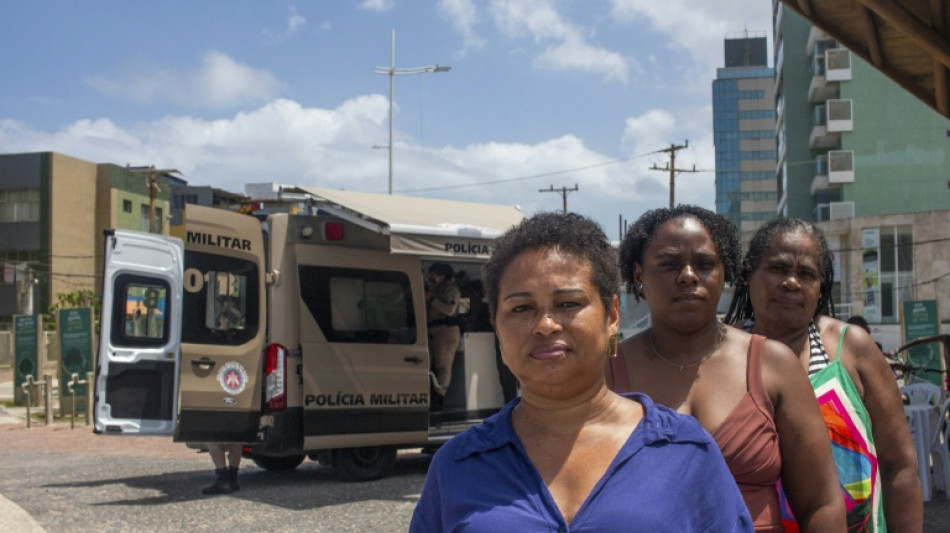
Women await justice for police killings in Brazil / Photo: AMANDA COTRIM - AFP
The sea, facing a favela in Brazil's northeastern city of Salvador, serves as a backdrop for the last photograph Vilma Alves de Oliveira has with her son, who she claims was killed by police three years ago.
Joao Vitor, who worked as a pizza maker, was 20 years old when he went out for a beer with a friend in 2023. Witnesses told Oliveira that police showed up and opened fire.
"No mother is prepared to lose a child, much less in this way. My son's life was taken by the police, the armed wing of the state," said Oliveira, 49, who is Black and lives in the Nordeste de Amaralina complex.
The neighborhood, with its steep streets and the lingering scent of dende -- the palm oil central to cooking in Bahia -- is one of the epicenters of police violence in the state.
According to the Brazilian Public Security Yearbook, there were 1,570 deaths resulting from law enforcement operations in the state in 2025, the highest figure in the country.
Virtually none of the cases have resulted in legal proceedings.
After Joao Vitor's death, his mother said security camera footage vanished, witnesses backed out of testifying due to fear, and no ballistic analysis was ever conducted.
"It's my word against theirs. But I will keep fighting for the truth and for justice," said Oliveira, who cannot bring herself to walk down the street where her son died.
- Women fight for justice -
Insecurity is the main concern of Brazilian voters ahead of a presidential runoff election on October 25.
Leftist President Luiz Inacio Lula da Silva is seeking a fourth term in office in a race against right-wing senator Flavio Bolsonaro.
The Nordeste de Amaralina neighborhood is predominantly Black and home to around 80,000 people. Like many favelas in Brazil, it is under the thumb of criminal groups who vie for control.
Police violence in Brazil is rooted in "structural racism," said Bianca Souza, a lawyer with the Odara Institute, which provides counsel to affected families.
"Young Black men from the periphery have historically been the primary targets" of police operations, she said.
According to the security yearbook -- an annual report on crime, violence, and policing -- more than 80 percent of those killed in police operations in 2025 were Black. Most were men between the ages of 15 and 29.
"It is the women, those who cover the bodies of their loved ones, who organize themselves," in pursuit of justice and policy change, said Souza.
Rita Cassia Souza dos Santos, a 59-year-old domestic worker, has been waiting thirteen years for the trial of three police officers accused of killing her only son, Carlos Alberto, in 2013, when he was 21.
"The police tried to tarnish his name and link him to drug trafficking to justify his death," she said.
The Bahia military police did not respond to AFP's requests for comment.
Bahia's public security secretariat has announced a plan to implement 1,300 body-worn cameras to monitor police conduct. It confirmed that it does not provide social assistance to the victims of lethal force by police officers.
- 'Bad with Lula, worse without' -
The activism of wives and mothers has helped advance the "Ana Luiza" bill in Bahia, which proposes medical, financial, and psychological support for victims of police operations.
The bill is named after a 19-year-old woman who was killed during a police operation in Salvador in 2025.
Elisangela Souza Santos, 37, said she was pregnant when police burst into her home and killed her 29-year-old husband, Marivaldo.
"I am more afraid of the police than I am of drug traffickers," she told AFP.
Lula, whose Workers' Party has governed Bahia for 20 years, promises to create a public security ministry and weaken criminal gangs by strangling them financially.
Flavio Bolsonaro has proposed building more prisons and said even El Salvador President Nayib Bukele's controversial model of mass incarceration of gang members "seems too mild" for Brazil.
"I don't trust any politician. But if Flavio Bolsonaro is elected president, our situation will get much worse," said Souza Santos, recalling the rule of his father, the far-right leader Jair Bolsonaro from 2019 to 2022.
"Bad with Lula, much worse without Lula," she said.
F.Carpenteri--NZN