'Sport of the future'? Padel's Miami boom augurs US expansion / Photo: Jason Koerner - GETTY IMAGES NORTH AMERICA/AFP
Padel, the racket sport that originated among the elites of Latin America and Spain, has exploded in popularity in Miami.
Fans say it will conquer the rest of the United States, and the world.
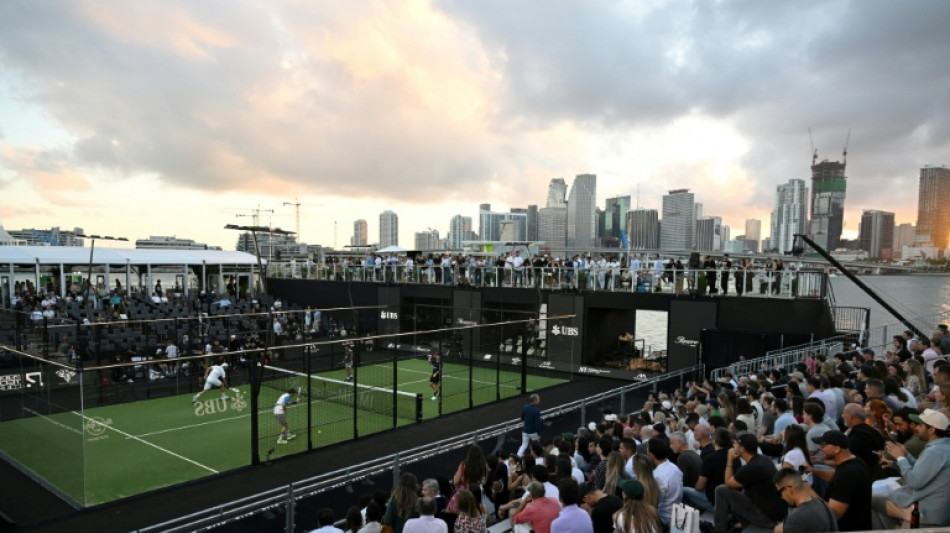
A cross between tennis and squash, played on courts surrounded by glass walls, the sport has quickly become a key part of the Florida lifestyle, adopted first by Miami's Latino community and now spreading to clubs, parks and luxury hotels.
Entrepreneurs have rushed to build courts, hoping to cash in on a buzzy new hobby that is usually played by teams of two, and offers the health benefits of physical exercise with a chance to socialize and make new acquaintances.
Florida accounts for 40 per cent of all padel courts in the US. Construction has doubled over the past year-and-a-half nationwide, though the country's approximately 770 courts still lag behind Argentina (7,000) or Mexico (2,500).
"The United States is a new market, but the only thing padel needs is time. Wherever the sport takes root, it thrives," said Argentine star Fernando Belasteguin, widely considered the greatest player in the sport's history.
"It is the sport of the future... It's easy to learn, fun, and social," he told AFP, with unwavering optimism.
"It's played by both men and women -- anyone from a five-year-old child to an 85-year-old grandfather can play."
- Olympic bid -
Padel shares many similarities with tennis, including its scoring system and the layout of the court -- although the playing surface is roughly one-third the size.
Aside from the key fact that players can hit the balls off any of the glass walls, there are other differences. For instance, serves are always underarm.
Padel has been taken up by stars across the sporting spectrum.
Footage on social media of soccer icons Lionel Messi and Cristiano Ronaldo, as well as Formula 1 driver Max Verstappen, playing padel have boosted the game.
Some have even opened their own branded padel centers, including tennis great Rafael Nadal in Spain, and football icons Zinedine Zidane in France and Neymar in Brazil.
Brazil is a key expansion target, with an estimated 600,000 players.
"I've never had so many students," said Jefferson Velho, a coach at Sao Paulo's Santo Padel Academy, which uses converted former futsal courts.
Padel is vying for inclusion in the 2036 Olympics. Qatar, a major sponsor of padel's official global tour, is expected to bid to host the Games.
The sport's ambition has been held back by the concentration of interest in a small number of countries. Spain and Argentina account for 90 per cent of the players in the global top 50.
That could be changing. The second edition of the Miami Premier Padel tournament concluded Sunday, with the now-retired Belasteguin serving as its director.
Some 5,000 fans turned out to enjoy the final stages of the event.
"Padel originated in the late 1960s in Mexico and was exported to Argentina and Spain. And Miami is, by definition, a Latin American hub," explained Sergio Montaner, owner of the city's Wynwood Padel Club.
- Pickleball rivalry -
So far, the Miami event the only US stop on the Premier Padel world tour.
Padel has encountered a particular challenge in expanding across the rest of the country.
Just as Floridians were embracing padel during the pandemic, Americans elsewhere were flocking to play the homegrown sport of pickleball, which is also played in doubles and uses smaller courts than tennis.
"Between 2018 and 2021, 90 per cent of our clients were Latin Americans or Europeans," said Montaner.
"But that is changing more and more."
Just a few blocks from Montaner's club, a diverse group of enthusiasts played a recent Sunday tournament at the Real Padel club, the sport's oldest venue in the city.
Danny O'Neill, a 34-year-old lawyer who primarily works with clients in fashion and plays three or four times per week, said he appreciates the sport's social benefits, as well as the chance to get a workout.
"It has that same networky vibe that golf has. You go and meet cool people on the court and end up doing business with them, for sure," he said.
Club owner Montaner said that because courts are more expensive to build than those for tennis or pickleball, padel still carries a "somewhat more elitist, or less democratic, bias."
But he predicted that -- like in Spain and Latin America -- as more courts are built, it will become more affordable.
F.E.Ackermann--NZN