Zürcher Nachrichten - Time appears five times slower in early universe: study

EUR -
AED 4.23597
AFN 75.541776
ALL 92.900361
AMD 421.467492
AOA 1058.847467
ARS 1719.769702
AUD 1.634005
AWG 2.079055
AZN 1.957941
BAM 1.954764
BBD 2.322339
BDT 142.344559
BHD 0.434764
BIF 3446.828399
BMD 1.153429
BND 1.476798
BOB 13.692684
BRL 5.94927
BSD 1.152984
BTN 109.985232
BWP 15.563684
BYN 3.418344
BYR 22607.202462
BZD 2.318941
CAD 1.606778
CDF 2624.05054
CHF 0.936927
CLF 0.026787
CLP 1054.257452
CNY 7.780226
CNH 7.783729
COP 3618.340425
CRC 522.816115
CUC 1.153429
CUP 30.56586
CVE 110.204205
CZK 24.255682
DJF 205.330287
DKK 7.475729
DOP 67.233493
DZD 153.427492
EGP 58.01518
ERN 17.30143
ETB 186.505012
FJD 2.551903
FKP 0.853593
GBP 0.854074
GEL 3.016249
GGP 0.853593
GHS 13.565987
GIP 0.853593
GMD 84.777861
GNF 10125.414192
GTQ 8.796147
GYD 241.480971
HKD 9.050736
HNL 30.904951
HRK 7.534886
HTG 150.758139
HUF 365.106684
IDR 20616.384531
ILS 3.459883
IMP 0.853593
INR 110.066513
IQD 1510.499454
IRR 1585618.430118
ISK 141.998398
JEP 0.853593
JMD 182.422528
JOD 0.817766
JPY 183.867494
KES 149.254038
KGS 100.867409
KHR 4671.463431
KMF 492.514136
KRW 1632.632678
KWD 0.356522
KYD 0.960799
KZT 537.683757
LAK 26014.874122
LBP 103253.33423
LKR 385.57732
LRD 208.118797
LSL 18.71114
LTL 3.405775
LVL 0.697698
LYD 7.353071
MAD 10.682592
MDL 20.028125
MGA 4961.349039
MKD 61.492143
MMK 2422.127382
MNT 4148.497053
MOP 9.318761
MRU 46.085976
MUR 54.291383
MVR 17.820925
MWK 1999.331712
MXN 19.679857
MYR 4.718216
MZN 73.054802
NAD 18.7096
NGN 1571.435549
NIO 42.426962
NOK 10.952671
NPR 175.974447
NZD 1.965806
OMR 0.443501
PAB 1.152984
PEN 3.898034
PGK 5.17419
PHP 70.6452
PKR 320.053388
PLN 4.301153
PYG 6865.27221
QAR 4.203181
RON 5.240259
RSD 117.359066
RUB 95.099756
RWF 1698.392511
SAR 4.32277
SBD 9.302449
SCR 15.924051
SDG 692.637883
SEK 10.991345
SGD 1.477144
SLE 28.259393
SOS 658.947909
SRD 43.768058
STD 23873.645266
STN 24.486492
SVC 10.088653
SZL 18.700008
THB 38.204443
TJS 10.625223
TMT 4.048535
TND 3.385432
TRY 55.084286
TTD 7.808117
TWD 37.151362
TZS 3056.295407
UAH 51.734157
UGX 4289.782256
USD 1.153429
UYU 46.425194
UZS 13709.73401
VES 876.911697
VND 30133.901425
VUV 136.615329
WST 3.148849
XAF 655.606695
XAG 0.017699
XAU 0.000263
XCD 3.117198
XCG 2.078099
XDR 0.815364
XOF 655.606695
XPF 119.331742
YER 273.588946
ZAR 18.671502
ZMK 10382.245802
ZMW 21.619261
ZWL 371.40357
  • RBGPF

    2.2800

    72.16

    +3.16%

  • RYCEF

    -0.0200

    20.55

    -0.1%

  • CMSD

    -0.0600

    21.63

    -0.28%

  • CMSC

    -0.1300

    21.44

    -0.61%

  • NGG

    0.7900

    80.27

    +0.98%

  • RIO

    -0.9200

    100.99

    -0.91%

  • BCE

    0.8300

    23.37

    +3.55%

  • RELX

    -0.2500

    35.37

    -0.71%

  • VOD

    0.1500

    15.9

    +0.94%

  • GSK

    -1.2600

    50.9

    -2.48%

  • AZN

    -3.1600

    158.75

    -1.99%

  • BCC

    0.7800

    85.53

    +0.91%

  • BTI

    -0.2400

    56.81

    -0.42%

  • JRI

    0.0000

    12.73

    0%

  • BP

    0.2800

    43.16

    +0.65%

Time appears five times slower in early universe: study
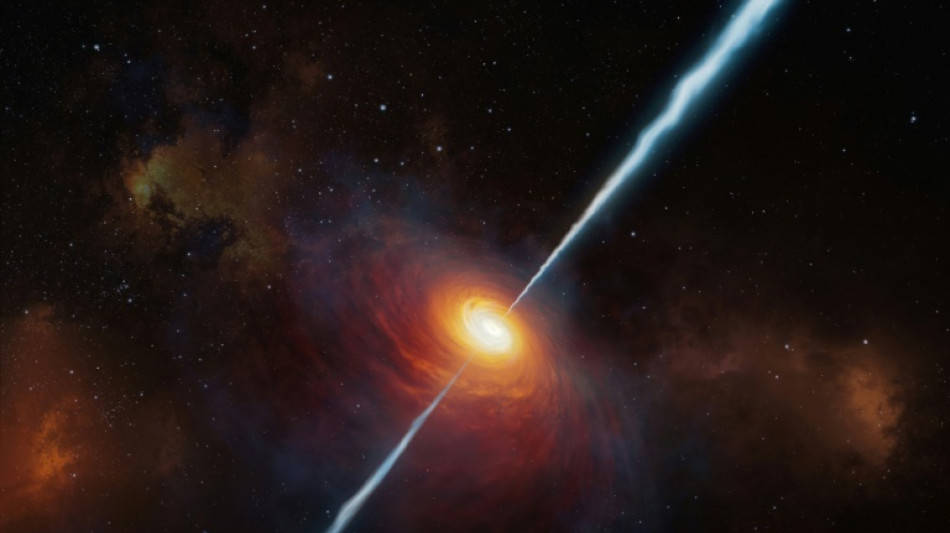
Time appears five times slower in early universe: study / Photo: M. KORNMESSER - European Southern Observatory/AFP/File

Time appears five times slower in early universe: study

Time appears to run five times slower in the early universe, scientists said on Monday, for the first time using extraordinarily bright cosmic objects called quasars as "clocks" to confirm this strange phenomenon.

Text size:

Einstein's theory of relativity predicts that because space is expanding, "we should see the distant universe run in slow motion," said Geraint Lewis, an astrophysicist at the University of Sydney and the lead author of a new study.

Researchers had previously used observations of very bright exploding stars called supernovas as cosmic clocks to show that time ran twice as slowly back when the universe was half its current age.

The new study used even brighter quasars to peer further back into the history of the 13.8-billion-year-old universe.

Just over a billion years after the Big Bang, time appeared to flow five times slower, according to the study in the journal Nature Astronomy.

While "everything looks like it's slowed down" from here, Lewis emphasised that the experience of time in these distant places was not different.

"If I could magically transport you back 10 billion years and drop you next to one of these quasars, and you've got a stopwatch, time would just be normal," he told AFP.

"One second would be one second."

- Cosmic clocks -

Aiming to measure this phenomenon, which is called cosmological time dilation, Lewis and University of Auckland statistician Brendon Brewer analysed data from 190 quasars collected over two decades.

Quasars -- supermassive black holes at the centres of distant galaxies -- are thought to be the brightest and most powerful objects in the universe.

This makes them "useful beacons for charting the universe," Lewis said.

But they have proved more difficult to turn into cosmic clocks than supernovas, which provide a reliable single flash as a "tick".

Previous attempts to use quasars to measure time dilation had failed, leading to some "strange suggestions," Lewis said.

These included theories that perhaps quasars were not as distant as had been thought -- or even that "something fundamental was broken" in cosmology, he said.

But the new research "puts everything back in the right place," Lewis said.

It also confirmed that "Einstein is right again," he added.

The researchers were able to succeed where other attempts had fallen short because they had far more data on quasars, according to Lewis. Recent advances in the statistical understanding of randomness also helped.

To turn quasars into clocks with measurable ticks, the researchers had to make sense of the turbulent explosions that occurred as the black holes swallowed material.

Lewis compared it to watching a fireworks display, in which the great flashes seem random but different elements are "brightening and fading on their own kind of timescales".

"What we have done is unravel this firework display, showing that quasars, too, can be used as standard markers of time for the early universe."

M.J.Baumann--NZN