Zürcher Nachrichten - Black hole observed 'awakening' for the first time

EUR -
AED 4.248105
AFN 75.770596
ALL 92.830359
AMD 423.156353
ANG 2.0703
AOA 1061.880869
ARS 1706.354669
AUD 1.634265
AWG 2.083564
AZN 1.971037
BAM 1.956743
BBD 2.328663
BDT 141.919628
BGN 1.962242
BHD 0.436037
BIF 3456.475084
BMD 1.156733
BND 1.478902
BOB 13.474494
BRL 6.040925
BSD 1.156227
BTN 110.266145
BWP 15.57645
BYN 3.516708
BYR 22671.957183
BZD 2.325221
CAD 1.60514
CDF 2629.253412
CHF 0.941015
CLF 0.026895
CLP 1058.51481
CNY 7.800083
CNH 7.801606
COP 3644.771598
CRC 520.182191
CUC 1.156733
CUP 30.653411
CVE 110.322941
CZK 24.210763
DJF 205.574957
DKK 7.473191
DOP 67.676714
DZD 152.325697
EGP 57.668157
ERN 17.350988
ETB 187.022939
FJD 2.56037
FKP 0.857112
GBP 0.855002
GEL 3.019524
GGP 0.857112
GHS 12.660102
GIP 0.857112
GMD 85.024294
GNF 10156.334049
GTQ 8.821328
GYD 241.836558
HKD 9.077054
HNL 30.994814
HRK 7.534035
HTG 151.232041
HUF 363.017812
IDR 20622.34285
ILS 3.418265
IMP 0.857112
INR 110.600806
IQD 1514.621659
IRR 1590030.052589
ISK 142.166837
JEP 0.857112
JMD 183.099329
JOD 0.820169
JPY 184.272161
KES 149.519689
KGS 101.156702
KHR 4678.254774
KMF 493.925187
KPW 1041.059598
KRW 1638.477341
KWD 0.357061
KYD 0.963523
KZT 536.501043
LAK 26093.576298
LBP 103531.599032
LKR 384.738715
LRD 209.853842
LSL 18.703876
LTL 3.415531
LVL 0.699696
LYD 7.36193
MAD 10.723725
MDL 20.048876
MGA 4977.398953
MKD 61.563397
MMK 2428.460304
MNT 4161.151475
MOP 9.344704
MRU 46.43078
MUR 54.486429
MVR 17.871955
MWK 2004.766235
MXN 19.69164
MYR 4.726298
MZN 73.927211
NAD 18.703715
NGN 1572.659254
NIO 42.552716
NOK 10.922567
NPR 176.436714
NZD 1.963226
OMR 0.441083
PAB 1.156157
PEN 3.899682
PGK 5.193773
PHP 71.098608
PKR 321.135211
PLN 4.306226
PYG 6939.34455
QAR 4.21485
RON 5.236186
RSD 117.376006
RUB 97.377191
RWF 1700.222344
SAR 4.346103
SBD 9.310058
SCR 15.912008
SDG 694.622124
SEK 11.020235
SGD 1.479697
SHP 0.856984
SLE 28.344188
SLL 24256.10146
SOS 660.758451
SRD 43.926343
STD 23942.02751
STN 24.513298
SVC 10.116313
SYP 15039.835978
SZL 18.702146
THB 38.337629
TJS 10.676846
TMT 4.060131
TND 3.389734
TOP 2.785134
TRY 55.381697
TTD 7.833249
TWD 37.04043
TZS 3065.33888
UAH 51.722311
UGX 4295.33015
USD 1.156733
UYU 46.32453
UZS 13763.752692
VES 890.810236
VND 30246.82002
VUV 137.202351
WST 3.162108
XAF 656.273303
XAG 0.017873
XAU 0.000264
XCD 3.126128
XCG 2.08373
XDR 0.81787
XOF 656.307363
XPF 119.331742
YER 274.381102
ZAR 18.703491
ZMK 10411.984809
ZMW 21.850531
ZWL 372.467396
  • CMSC

    -0.0250

    21.45

    -0.12%

  • NGG

    -0.1500

    81.05

    -0.19%

  • BCE

    0.1500

    23.47

    +0.64%

  • CMSD

    -0.0100

    21.58

    -0.05%

  • RYCEF

    0.1300

    20.84

    +0.62%

  • RBGPF

    0.0000

    71.34

    0%

  • GSK

    -0.4785

    49.52

    -0.97%

  • BCC

    -0.8900

    83.24

    -1.07%

  • RIO

    -0.4100

    95.68

    -0.43%

  • BTI

    -0.2900

    57.06

    -0.51%

  • JRI

    0.0635

    12.61

    +0.5%

  • RELX

    -0.2400

    34.43

    -0.7%

  • VOD

    0.2000

    16.42

    +1.22%

  • BP

    0.2196

    42.53

    +0.52%

  • AZN

    -0.7900

    156.45

    -0.5%

Black hole observed 'awakening' for the first time
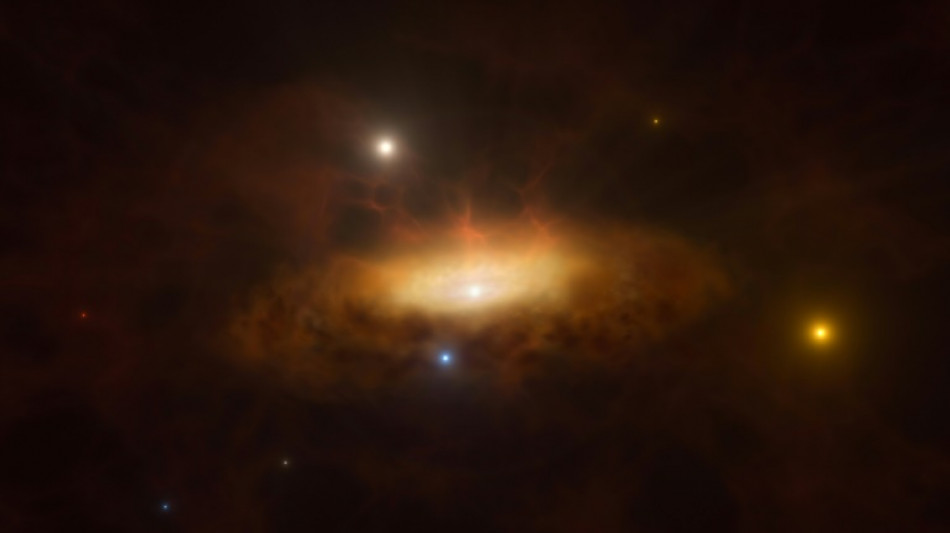
Black hole observed 'awakening' for the first time / Photo: ESO/M. Kornmesser - European Southern Observatory/AFP

Black hole observed 'awakening' for the first time

Astronomers have been able to observe a supermassive black hole waking up and setting the heart of its host galaxy alight for the first time, the European Southern Observatory said on Tuesday.

Text size:

The galaxy 300 million light years from Earth in the Virgo constellation had been quiet for decades until late 2019, when it suddenly began to shine brighter than ever before.

The centre of the galaxy -- where a supermassive black hole is believed to be squatting -- since then has been radiating a variety of rays.

"This behaviour is unprecedented," Paula Sanchez Saez, an European Southern Observatory astronomer and first author of a new study in the journal Astronomy & Astrophysics, said in a statement.

The "most tangible option" to explain this brightening is that the astronomers were watching "the activation of a massive black hole in real time", study co-author Lorena Hernandez Garcia said.

Most galaxies -- including our own Milky Way -- are believed to have a supermassive black hole at their centre.

These cosmic behemoths are by definition invisible -- not even light can escape the pull of their awesome power.

The only way to observe black holes is when they destroy something huge that lets off light in its death throes: such as a star that wandered too close being torn apart.

"These giant monsters usually are sleeping," study co-author Claudio Ricci explained.

But for the galaxy SDSS1335+0728, "we were able to observe the awakening of the massive black hole, (which) suddenly started to feast on gas available in its surroundings, becoming very bright," the astrophysicist added.

Initial observations indicate the black hole has 1.5 million times more mass than the Sun, enough for it to be classified as a supermassive black hole.

But it is still on the lighter side, as the true heavyweights easily exceed a billion times the Sun's mass.

The international team of astronomers is analysing data from a number of telescopes hoping to determine whether the black hole's activity is temporary -- perhaps caused by a star being ripped apart -- or whether it will continue to be active for a long time.

"This is something that could happen also to our own Sgr A*," the Milky Way's supermassive black hole, Hernandez Garcia said.

But fortunately for us, our own black hole remains fast asleep.

E.Schneyder--NZN