Zürcher Nachrichten - NASA solar probe to make its closest ever pass of Sun

EUR -
AED 4.170451
AFN 73.242251
ALL 92.171726
AMD 412.821247
ANG 2.033119
AOA 1041.335053
ARS 1731.77184
AUD 1.621087
AWG 2.045479
AZN 1.933318
BAM 1.95734
BBD 2.2877
BDT 139.652363
BGN 1.911697
BHD 0.428137
BIF 3403.578548
BMD 1.135589
BND 1.451142
BOB 13.692655
BRL 5.916186
BSD 1.135794
BTN 108.962751
BWP 15.509069
BYN 3.428498
BYR 22257.538233
BZD 2.284398
CAD 1.610123
CDF 2640.243458
CHF 0.945837
CLF 0.027764
CLP 1096.295012
CNY 7.620311
CNH 7.613475
COP 3825.696078
CRC 517.507268
CUC 1.135589
CUP 27.259453
CVE 110.351845
CZK 24.398916
DJF 202.259174
DKK 7.475242
DOP 67.543155
DZD 151.510422
EGP 59.129302
ERN 17.03383
ETB 185.525971
FJD 2.543434
FKP 0.856619
GBP 0.857159
GEL 2.946876
GGP 0.856619
GHS 13.238302
GIP 0.856619
GMD 84.033002
GNF 9989.86182
GTQ 8.671977
GYD 237.657031
HKD 8.909556
HNL 30.491997
HRK 7.536218
HTG 148.646982
HUF 366.337541
IDR 20384.952491
ILS 3.470243
IMP 0.856619
INR 108.893188
IQD 1487.971003
IRR 1561264.104697
ISK 136.804627
JEP 0.856619
JMD 179.811508
JOD 0.805164
JPY 178.352141
KES 147.183803
KGS 99.305296
KHR 4609.58706
KMF 491.710169
KPW 1022.030178
KRW 1536.763796
KWD 0.350397
KYD 0.946537
KZT 498.632414
LAK 25485.056225
LBP 101711.649342
LKR 375.965878
LRD 194.791582
LSL 18.607944
LTL 3.353098
LVL 0.686906
LYD 7.26559
MAD 11.000657
MDL 20.154684
MGA 5001.936423
MKD 61.6285
MMK 2384.022637
MNT 4084.964518
MOP 9.179505
MRU 45.478791
MUR 54.065325
MVR 17.555876
MWK 1969.549996
MXN 20.316902
MYR 4.635364
MZN 72.564373
NAD 18.607616
NGN 1505.142951
NIO 41.803635
NOK 10.873358
NPR 174.338666
NZD 2.007318
OMR 0.436632
PAB 1.135794
PEN 3.907044
PGK 5.139044
PHP 71.039589
PKR 314.650223
PLN 4.364533
PYG 6672.250927
QAR 4.140158
RON 5.278782
RSD 117.51524
RUB 95.52841
RWF 1677.005001
SAR 4.265854
SBD 9.114461
SCR 15.708503
SDG 683.054529
SEK 11.321104
SGD 1.450256
SHP 0.856692
SLE 27.933689
SLL 23812.717718
SOS 649.105117
SRD 42.795832
STD 23504.393043
STN 24.519296
SVC 9.938822
SYP 14764.924376
SZL 18.603641
THB 38.050135
TJS 10.455228
TMT 3.97456
TND 3.371653
TOP 2.734225
TRY 55.644409
TTD 7.705064
TWD 36.121956
TZS 2992.279645
UAH 50.945996
UGX 4452.504031
USD 1.135589
UYU 45.535836
UZS 13425.565649
VES 972.876144
VND 29494.077131
VUV 135.040281
WST 3.144797
XAF 655.957
XAG 0.018619
XAU 0.000273262808
XCD 3.068985
XCG 2.047011
XDR 0.80292
XOF 655.957
XPF 119.331742
YER 268.708663
ZAR 18.585908
ZMK 10221.660683
ZMW 22.233301
ZWL 365.659093
SSP 6487.154725
MXV 2.300333
  • RYCEF

    0.4000

    19.71

    +2.03%

  • CMSC

    -0.1000

    20.3

    -0.49%

  • RBGPF

    0.5300

    65

    +0.82%

  • NGG

    -0.9750

    74.265

    -1.31%

  • BCC

    -0.3800

    76.21

    -0.5%

  • RIO

    0.0700

    94.48

    +0.07%

  • BCE

    -0.1600

    20.4

    -0.78%

  • GSK

    -0.6200

    49.08

    -1.26%

  • VOD

    -0.2250

    16.355

    -1.38%

  • AZN

    -2.1500

    164

    -1.31%

  • RELX

    0.1500

    33.22

    +0.45%

  • JRI

    0.0810

    10.851

    +0.75%

  • BP

    -0.5850

    43.845

    -1.33%

  • CMSD

    -0.1400

    20.13

    -0.7%

  • BTI

    -1.5000

    54.55

    -2.75%

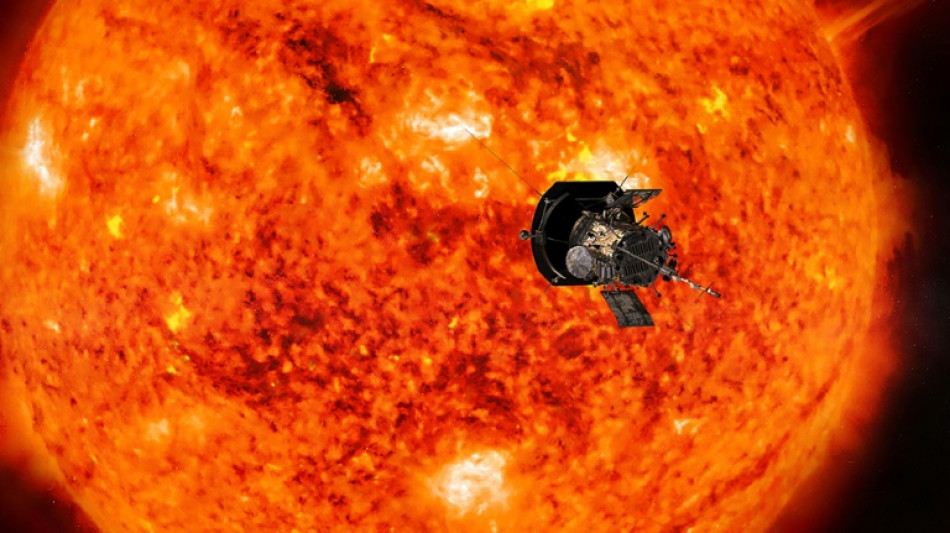
NASA solar probe to make its closest ever pass of Sun
NASA solar probe to make its closest ever pass of Sun / Photo: HO - NASA/Johns Hopkins APL/AFP/File

NASA solar probe to make its closest ever pass of Sun

NASA's pioneering Parker Solar Probe is poised to make its closest-ever approach of the Sun on Christmas Eve, a record-setting 3.8 million miles (6.2 million kilometers) from the surface.

Text size:

Launched in August 2018, the spaceship is on a seven-year mission to deepen scientific understanding of our star and help forecast space-weather events that can affect life on Earth.

Its closest approach to date will happen on Tuesday, December 24, at 6:53 am (11:53 GMT).

If the distance between Earth and the Sun is the equivalent to the length of an American football field, the spacecraft would be about four yards (meters) from the end zone at that point.

"This is one example of NASA's bold missions, doing something that no one else has ever done before to answer longstanding questions about our universe," said Arik Posner, Parker Solar Probe program scientist, in a statement.

"We can't wait to receive that first status update from the spacecraft and start receiving the science data in the coming weeks."

During this closest approach -- known as perihelion -- mission teams will lose direct contact with Parker, relying on a "beacon tone" this Friday to confirm the spacecraft's status.

Although the heat shield will endure scorching temperatures of about 1,600 to 1,700 degrees Fahrenheit (870 to 930 degrees Celsius), the probe's internal instruments will remain near room temperature -- around 85F (29C) -- as it explores the Sun's outer atmosphere, called the corona.

Not only will the temperatures be extreme, but Parker will also be moving at a blistering pace of around 430,000 mph (690,000 kph), fast enough to fly from the US capital Washington to Tokyo in under a minute.

"No human-made object has ever passed this close to a star, so Parker will truly be returning data from uncharted territory," said Nick Pinkine, Parker Solar Probe mission operations manager at the Johns Hopkins Applied Physics Laboratory (APL) in Laurel, Maryland.

"We're excited to hear back from the spacecraft when it swings back around the Sun."

By venturing into these extreme conditions, Parker has been helping scientists tackle some of the Sun's biggest mysteries: how the solar wind originates, why the corona is hotter than the surface below, and how coronal mass ejections -- massive clouds of plasma that hurl through space -- are formed.

This Christmas Eve flyby is the first of three record-setting close passes, with the next two -- on March 22, 2025, and June 19, 2025 -- both expected to bring Parker Solar Probe back to a similarly close distance from the Sun.

P.Gashi--NZN